Trading Power for Love, Joy, and Peace
When we let go of power and control, when we love our neighbor as ourselves, we end up like the wise men, overwhelmed with unspeakable joy.
Christmas 2, RCL, All Years
Sermon for January 4, 2026
My friends, I speak to you today in the name of one God, Father, Son, and Holy Spirit. Amen. Please be seated.
Good morning, Epiphany. Happy New Year. And yes, still, Merry Christmas! Today’s second Sunday after Christmas falls on the 11th of the 12 days of Christmas this year, so according to the song, today we can all expect some pipers-piping... or lords-a-leaping, depending on what version you grew up singing, the last four gifts have kind of rotated over the years. It doesn’t matter, either way, you’re getting a lot of people? Who knows.
What I do know is that this is an extraordinary weekend to preach for priests and pastors and deacons across our country. I’ll get to the extraordinary part in a minute, but this morning, those putting together the liturgy for the second Sunday of Christmas had a few choices in the lectionary, we could choose between three different gospel passages. Because we celebrate Epiphany on Tuesday around here, our namesake, patronal feast on the Feast of the Epiphany, our liturgy team chose this passage from the beginning of Matthew 2 for today, to keep everything in chronological order. The story we read this morning, of “wise men from the east,” it comes directly after Matthew’s brief account of the birth of Jesus the Messiah. In Matthew, we have, “When Joseph awoke from sleep, he did as the angel commanded him, he took Mary as his wife but had no marital relations with her until she had given birth to a son, and he named him Jesus.” Merry Christmas. And then we have this, “In the time of King Herod, after Jesus was born, wise men from the East came to Jerusalem.” This morning, we have the direct continuation of our Christmas story; for Matthew, a very brief time spent at the manger, and now, this.
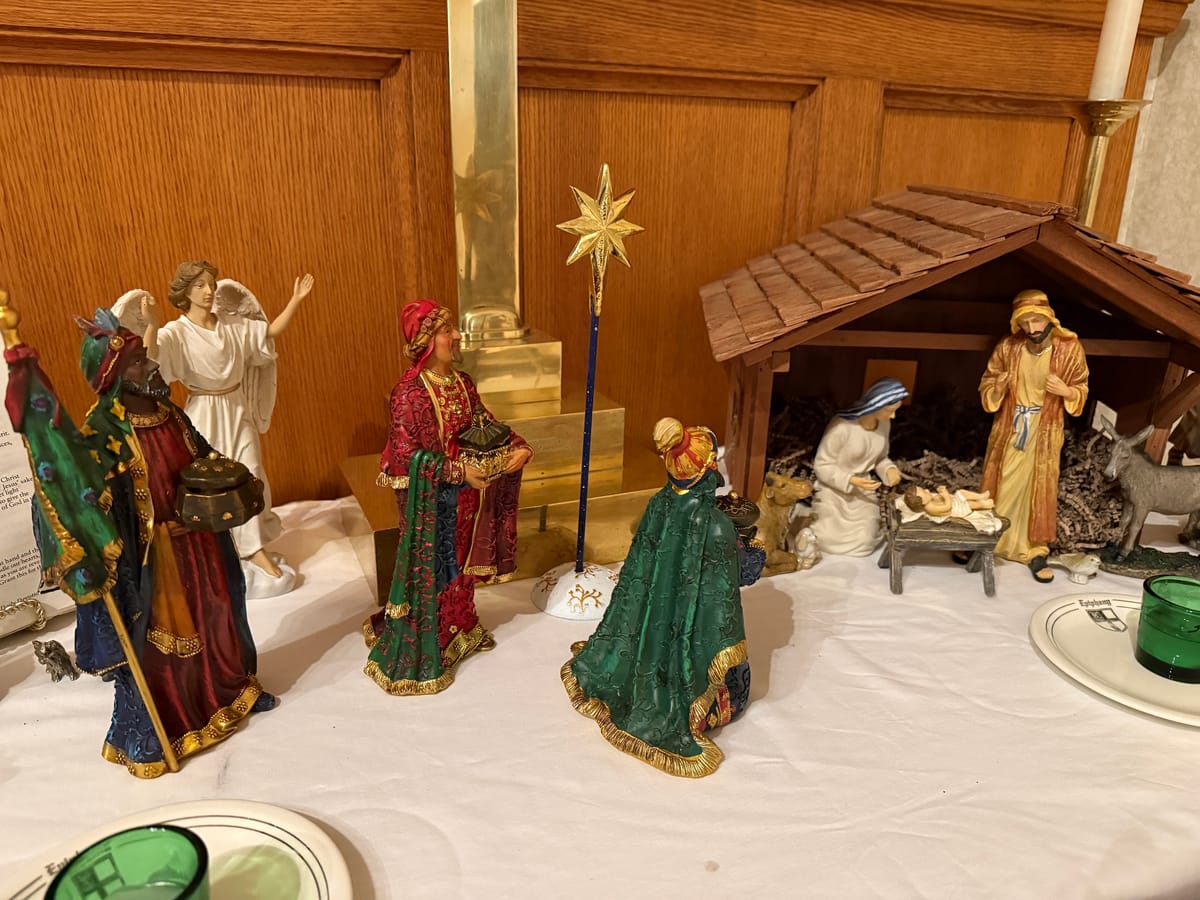
So, our story this morning rounds out many of our nativity scenes, with the three wise men, who are often depicted on camels, right? This is the tradition. But when this story lines up with the events of yesterday, with a CIA/U.S. military strike on Venezuela, with the arrest of a foreign president to come be incarcerated and to stand trial in our judicial system... when you read about King Herod in one hand and then read the news in the other, well, you have an extraordinary Sunday. We have had a few Sundays like this recently, where the sermon needs to be rewritten given the events of the Saturday before it. And it is a privilege to be able to “love the scriptures in public” with you as your priest and your 40+ Sundays per year preacher. On my very first Sunday at Epiphany, I quoted Ellen Davis, who wrote “The task of the preacher is to love the scriptures in public.” But there’s another task for a priest, and that is to try to understand, interpret, and love the current times, our lives, through scripture and through our faith in Jesus, in a loving God.
This morning, preachers and really all Christians across the country should be grappling with an extraordinary Sunday, the confluence of our gospel text and our lived experience as Americans in 2026, the confluence of King Herod and the wise men with what is now arguably considered “life under an American empire” here in the Western Hemisphere.
I will not dive too deeply into the latter, I will leave our current President’s (and previous Presidents’ before him), I will leave most of their oily, imperial aims to the discussion of history professors and political pundits. I majored in U.S. History and Politics in college back in the day, but I would not consider myself overly qualified to dive in too deeply there, on the comparisons between this administration and other imperialist regimes, on what we must do to combat them, to resist them (though I have some ideas). But I do think I am qualified, I hope, to reflect a little bit on power. As the rector of an Episcopal church, I myself have been given a small amount of power; our polity puts me in charge of a few things around here, whether I (or you!) like it or not. The buck kind of stops with me. Sometimes, I bristle at that, sometimes I have to own it, but power – again, a very small amount – power is part of this gig. I am grateful to be in a position where you were without a rector for a long time, and so much of that power has been held collectively, in love, in grace for each other. I experience your love and grace in this work all the time.
Many of you have held small or perhaps even larger amounts of power over the course of your careers, as doctors, or teachers, or even as skilled handymen. I realized last Sunday when we had a small leak in our kitchen during brunch that I was at the whims of those who knew more than I did, who had some amount of power over whether our kitchen would be fixed or flooded. Thanks to a few of you, that leak was quickly fixed. But in the moment last Sunday, after most of us had gone home, I will admit to feeling powerless.
That brief feeling of powerlessness was difficult, as it can often be. I knew we were in good hands here, that Epiphany was not and never will be completely reliant on me or any one person. But powerless I still felt, and powerlessness can be difficult, it can be frightening. We may feel truly powerless when we get a bad medical diagnosis. We may feel powerless when relationships are falling apart. Those under attack in Venezuela on Saturday certainly felt powerless; as many around the world knew in 2025, powerlessness comes part and parcel when bombs are falling from the sky. Powerlessness when you are outside the halls of power, for those on the margins, it can be a matter of life and death.
But when we ourselves become too focused on power, when we become fixated on ourselves and our own power and position in the world, well, we can never have enough. Power inevitably leads us to fear; holding power leads us to looking out for threats, to viewing others through a lens of “Who might take this away from me?” Today, it leads billionaires to cutthroat business practices; it leads politicians to unethical decisions, always concerned about the next election, the possible loss of their power. And yes, power, and concerns around maintaining power, they often lead nations to acts of war.
For King Herod, to come back to our scripture reading this morning, his fear of losing his own lofty position led him to unspeakable things. King Herod was a truly evil man, by all historic accounts. Herod killed his wife and two of their sons because he considered them a threat to his throne. He murdered 46 members of the Sanhedrin, the Jewish governing body; he drowned his wife’s brother in his palace swimming pool. He came to power in violence and did not stop once he had it; Matthew 2:16-18 marks the massacre of the holy innocents, as we mark it in the church today, where, because of the events in today’s gospel, Herod ordered the death of all the children in the region under the age of two.
And so, King Herod, the most powerful man in the region, he lives a truly miserable life, one of fear, of violence, of perceived threats, a life built on the consolidation of power, wealth, all things for himself, a life that leads him to the killing of innocent children.
In sharp contrast to all of that, thankfully, we have today’s story, where wise men from the East come to Jerusalem looking for the new king of the Jews, to pay him homage, to give him gifts and to worship him. These men are following a star in the sky, an act of incredible faith when you think about it; their understanding of the world was informed by the cosmos, not what they could see and touch and scientifically explain, but on messages in the sky, from the natural world. They observed a star and they knew from prophecy that a new king had been born; they traveled hundreds of miles and then found this newborn king not in a fancy hall nor a governmental palace ordained with the finest gold applique, but in a humble home, born to a humble family on the margins. They still worshiped him, and the gospel text says, “they were overwhelmed with joy.” I touched on this in my enotes newsletter this week, on joy, on the moments of joy that we can and need to celebrate amid a broken world. These wise men were overwhelmed with joy. Then, of course, the last verse: the wise men decide not to return to Herod, who they’d initially asked for help. They leave him behind, and they leave for home by another road.
Friends, this morning, we have two roads, two paths that we can take, two clear examples of living in this world. First, we have King Herod, who rules in unspeakable violence, in paranoia, desperately trying to hold on to his power, deviously asking these wise men to report back to him on the location of the new king of the Jews, a title not afforded to Jesus again until his crucifixion, so that he can kill this baby on the humble margins. And, we have the wise men, men who travel from afar, following a star, to worship that baby, to lay their riches at his feet, who have little concern about maintaining their own position or gaining power for themselves, who are overwhelmed with joy that they get to pay homage, to visit with the Messiah and his family. There could not be a sharper contrast.
When we cling to power, when we are fearful, when we look to dominate others, when we see the world through a lens of threats to eliminate, when we hold on to control as though that is all that matters, when we cease to see the humanity of those around us... well, we end up like Herod, miserable, joyless, even despised, ruining everything good around us, never able to experience a moment of peace, unable to fathom selfless love.
But when we let go of power and control, when we embrace freedom from fear, freedom from power plays or pedestal sitting, freedom from climbing the ladder or our own selfish ambition, when we truly see the humanity of those around us, when we set our hearts on loving and welcoming everyone, when we love our neighbor as ourselves, when we strive to live at peace... well, we end up like the wise men, overwhelmed with unspeakable joy and in the presence of the incarnate God.
Ours is a story of joy, this Christmas, we will sing "Joy to the World" again to end our service this morning. Ours is a story of unbelievable love and of overwhelming joy. We see what the opposite of that joy looks like... paranoia and fear, violence and oppression, domination and war, every time we turn on the news. May we as Christians in 2026 choose to embrace the joy instead, may we choose to love instead, may we choose peace instead... may we hold on to that love, joy, and peace tightly... and may we, like the wise men, rejoice in the presence of King Jesus and leave King Herod behind, always choosing to walk down a better, joyful, loving, and peaceful road.
Amen.