Childlike Joy and Peace on Earth
This is the season of joy because of an act of love so radical and unbelievable, a love that can and will transform everything.

Christmas Eve, Selection I, RCL
Sermon for December 24, 2025
My friends, I speak to you tonight in the name of one God, Father, Son, and Holy Spirit. Amen. Please be seated.
Well, merry Christmas, Epiphany! We have eight hymns in tonight’s bulletin, so I promise to keep this sermon a bit shorter than my usual. It’s good to be with you tonight.
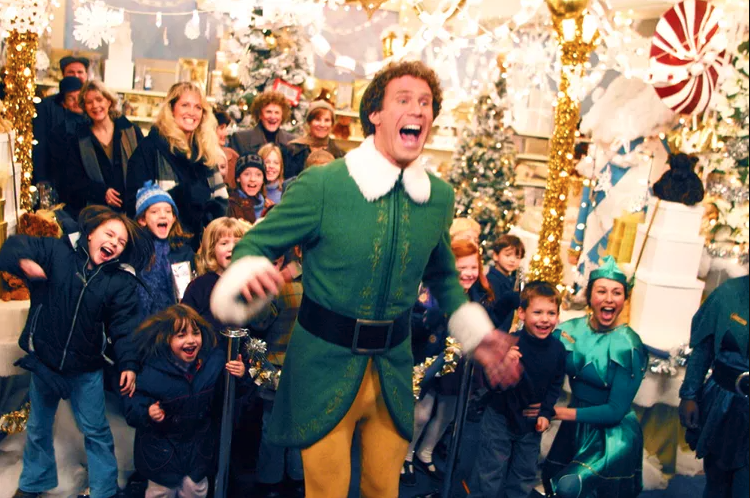
I made that promise to you last year, to keep the Christmas Eve sermon a little shorter than usual, and I did, I preached a little bit about love, joy, God’s willingness to be with us in the muck and the mire of life instead of staying in the clouds and in the fire, on the ethereal and spiritual plain. It’s an amazing gift, this incarnation. But I preached last year using the lens of the Muppet Christmas Carol, Kermit and Miss Piggy, and a song lyric, “wherever you find love, it feels like Christmas.” Well, that is all still true, I could probably preach the same sermon and few of you would realize or mind that I had done so. But this year, though the readings and the story stay the same, I’m going to switch lenses, to preach about the goodness of Christmas through another Christmas movie, this time, Will Ferrell’s 2003 movie and modern classic, at least in our house, the movie Elf.
The fact that Elf came out in the twenty-first century and not the twentieth means that it might not be a classic for many of you, and I hope that’s okay, maybe next year I’ll use It’s a Wonderful Life. But I vividly remember seeing Elf for the first time, in theaters that year, because I saw it in my college town of Kankakee, Illinois, on a first date. (No, there was not a second date, much to my dismay.) Elf surprised and delighted those of us in the theater that night with Will Ferrell’s ridiculous, over-the-top, comedic, childlike character Buddy. Buddy, for those of you who haven’t seen it every year since 2003 like I have, Buddy was a human orphan accidentally taken to the North Pole by Santa. He was then raised as an elf by Papa Elf, played by Bob Newhart, until Buddy finds out that he’s a human and decides he needs to find his real dad, Walter Hobbs, played by James Caan.
I won’t go through the entirety of the movie tonight, that’s not why you’re here, but what is inescapable in a viewing of Elf is the childlike joy and wonder of the main character, Buddy. He walks through New York City with the biggest of eyes: he gawks at every Christmas tree, he eats gum off of railings, he tries to hug a raccoon. Buddy runs around and around in circles in one of those rotating doors, he congratulates those at a local diner who sell the “world’s best cup of coffee” with the exclamation, “Wow, you did it!”
Now, that level of joy might be difficult, or it might feel ignorant or irresponsible even, for some of us. We know that the holidays can be difficult, especially for those of us who have lost loved ones, those who have broken relationships with family and friends, those who are in the midst of difficult health challenges. Joy is hard to come by for many, even on a night like this. But are we not to sing “Joy to the World” anyway? Do we just sing it with our fingers crossed? “Oh come, all ye faithful, weary and barely hanging on?” No, of course, it’s “joyful and triumphant.” “Shepherds, why this jubilee, why these songs of happy cheer. What great brightness did you see? What glad tidings did you hear?” This is a night, a celebration of God come to earth, one of the most miraculous events in history.
Again too though, it can be difficult to feel childlike joy when we look around us, when we read the news, when we’re serving those in dire need more than ever, thanks in part to the decisions and actions of all those in power. Is it irresponsible to be joyous? Are the joyous simply ignorant, or do they have an easier, sheltered life? To that point, we have “I Heard the Bells on Christmas Day,” a poem written by Henry Wadsworth Longfellow in 1863 and turned into song soon after. Longfellow’s wife had died in an accidental fire in 1861, and his eldest son had run off to join the Union Army and was shot in November of 1863, and nearly paralyzed. Longfellow’s country was literally falling apart around him, his personal life was falling apart too, and yet he needed to celebrate Christmas.
On Christmas Eve, 1863, he wrote these words, sung since by Bing Crosby and Frank Sinatra, among many others: “I heard the bells on Christmas Day, their old, familiar carols play, and wild and sweet, the words repeat, Of peace on earth, good-will to men!” The poem continues through the declaration of war by the South, through Longfellow’s own personal tragedies. He concludes it with: “And in despair I bowed my head; ‘There is no peace on earth, I said; ‘For hate is strong, and mocks the song, of peace on earth, good-will to men!’ Yet pealed the bells more loud and deep: ‘God is not dead, nor doth He sleep; the Wrong shall fail, the Good prevail, with peace on earth, good-will to men!’”
This celebration, this Christmas, it does not rely on our good disposition, our happy situations, our perfect health, nor even a well-running society. In truth, the beauty of Christmas is all the more powerful amid difficult times, when we need reminders that God did not sit this one out, that God entered into the world to be with us, God entered the world as a vulnerable infant to a young woman on the margins of power. The almighty creator God of the universe came to life as each of us does, as an infant, and then was wrapped in cloths and laid in a manger, for there was no room for them in the inn. We, as Christians, we often want to look to the sky for something amazing and transcendent, and God says, the amazing and transcendent is here, with you, in this human life. “Let me come and save you,” God says, “let me show you the way. Let me be with you and let me show you a love that will change everything, if you let it.”
What that truth, what this event brought to the shepherds in the fields, what this incarnation brought to all who heard the news in the first century was joy, unbelievable, life-changing joy. Their messiah had arrived; our messiah has arrived. Wise men traveled from afar to give this little family gifts well beyond their station. And we have glimpses of that first-century joy here tonight; parents will see glimpses of that kind of joy in children’s faces tomorrow morning too. And yes, I see glimpses of that joy in the ridiculousness of Will Ferrell’s Buddy the Elf. There’s something pertinent from later in Jesus’s life too, during his teachings and parables, where we hear the verse, “Unless you change and become like little children, you will never enter the kingdom of heaven.”
Friends, visitors, all who are here to celebrate Christmas tonight, no matter what else may be going on in your lives, in your world, this is the season of joy, childlike, unbelievable joy. Welcome to it. This is the season of joy because God came to be with us, Emmanuel. It is the season of joy because that act of love was radical and unbelievable and an example to us of how much love we too can have for this broken, struggling world, a love that can and will transform everything. And it is the season of joy because we are surrounded tonight, and whenever we choose to be part of the church, we are surrounded by those who want to sing about and live in this joy too.
The movie Elf ends with Jovie, the love interest played by Zooey Deschanel, echoing Buddy the Elf’s wisdom from earlier in the movie both in action and in word: “The best way to spread Christmas cheer is singing loud for all to hear.” They sing about Santa to help Santa’s sleigh fly through the night, but the line is true for us tonight too: We come together tonight to celebrate and to sing aloud about the joy of Christmas, about the joy of God with us, Jesus come to earth in a manger some two thousand years ago. We spread the joy of Christ by our singing, and we bring the joy of Christ to a world who needs it too. We sing and celebrate because and maybe even in order that we feel the joy ourselves.
So, let us sing loud for all to hear, tonight and every day, about the goodness of God’s incarnate love. And, as Longfellow would remind us... let the bells continue to ring, all year long, declaring joyfully and triumphantly, “Peace on earth, good-will to men!”
Amen.