Light and Hope Until the Very End
We know how to live in light of all that is to come, both personally, with our own endings, and cosmically, with the end of the world as we know it. We live in love.
November 30, 2025 - First Sunday of Advent
My friends, I speak to you today in the name of one God, Father, Son, and Holy Spirit. Amen. Please be seated.
Good morning, Epiphany. Or at least, good morning to those of you who were able to make it through the snow to be here. When I walked the dog last night, I opened the door to find the snow had drifted up to about three feet high... our puppy is about a foot tall. Lily and I couldn’t stop laughing about it, about the idea of just dropping him in, which we did not do... but I was not looking forward to the drive here this morning. Thankfully, we made it. Thankfully too, we were able to drive home from Tennessee before the worst of this first real winter storm of the season hit South Haven. We spent the holiday with Abbey’s family outside of Nashville, but it quickly became clear we’d need to head home earlier than expected to ensure we’d be here this morning. Thankfully, it all worked out.
Now, I realize we all probably spent our Thanksgiving holiday in different settings, with different people, different traditions, in different moods. Some of us spent the day alone, just another Thursday, while some of us probably decorated for Christmas. For some, holidays are difficult. Some of you traveled too. I usually love Thanksgiving; I love the food, the general focus on thankfulness, appreciation for what we have, even though it’s quickly overridden with Black Friday’s focus on what we do not have. I usually really enjoy the Ohio State-Michigan game as part of this time of year, though yesterday’s was not as enjoyable. This is supposed to be a festive, wonderful start to winter... Lily’s embargo on Christmas music lifted last night too, so we decorated our house, put up our tree, and listened to Frank Sinatra, Dean Martin, Mariah Carey, and Michael Buble.
But if I’m honest, this year, I have had trouble appreciating much of anything about this holiday week; my overriding feeling has been endurance, not thankfulness. A big reason my Thanksgiving this year was less joyful than most was my – your priest’s – slightly unhealthy preoccupation with death. Maybe that’s not where you expected the sermon to start this morning, with the church decorated for the season, especially for those of you who risked death to be here in person. But I couldn’t stop thinking about death this week.
On our way down to Tennessee on Wednesday, we spent 85 minutes parked on Interstate 65, just north of Bowling Green in Kentucky. When you’re parked that long, and when ambulances and fire trucks fly past you on the shoulder, you know something awful has probably happened. As I found out this morning, it was a five-car accident that delayed our travel plans, and in all my research, I’m pretty sure it was non-fatal, just a few injuries to the deeply unlucky travelers. But there’s part of you, after about 40 minutes maybe, that assumes someone must have died for us to be there that long. We couldn’t see the wreck, I can’t imagine how many cars were waiting there with us, but we left the scene that night assuming someone’s Thanksgiving holiday would never be the same.
I also, at Mary Moore’s recommendation, have been reading Atul Gawande’s book, Being Mortal. I finished it after the Macy’s Parade on Thursday; it’s a book about death, about the end, a book about what it’s like to deal with aging in 2025, with the medical industry, with nursing homes, with assisted living, with our own personal endings. We’re going to read it as a book study during Lent, I think (I’ll need to talk to Mary about the timing there), but there is nothing more grounding than to think about your own ending, or the endings of your loved ones. We try to ignore it in America in 2025, at least in many circles. It’s impolite to even talk about it, but we do all die, and we all age: we all struggle with our bodies as they regularly tell us they’re not as young as they used to be. I will not pretend to be too aged today (and yes, I know it will only get worse, you don’t need to tell me), but I tweaked my back lifting Jane last night so she could put the angel on top of our Christmas tree. Aging is not fun, let’s just never talk about aging or death, ever. ...No.
So happy holidays, everyone. Tragic death, aging, inevitably dying, that’s the message I have for you on the First Sunday of Advent. “Put up the Christmas lights, join me in thinking about your own mortality.” (Ha.) Actually, I’m only half kidding.
Our gospel message this morning is an odd one to read if you think that this season of Advent is solely about decorating for Christmas, about anticipating Jesus’s birth, the incarnation. Why would our liturgical year begin (Happy New Year, by the way), why would Advent begin with Matthew 24, with this passage, with a quote from Jesus that feels like something out of Revelation, something apocalyptic, especially in light of the Left Behind series and all the talk of the rapture we’ve heard mentioned twice in November’s readings? Why are we talking about one being taken and another left, Noah and the flood, the thief in the night?
Well, as you might have known, or as you might have guessed by now, we read this story because there’s more to Advent than decorating and preparing for Christmas. Advent is one of our “eschatological” times in the church calendar, one of the times where we do talk about the end times. For many of us (I think sadly), our understanding of “the end of the world as we know it,” it has been shaped by rapture theology, by a Calvinist, Brethren bible teacher. This man, named John Nelson Darby, resigned as an Anglican deacon in 1927, then he fell from his horse... then he proceeded to reshape everything taught about the end times through his books about the book of Revelation. They were popular books and teachings in the 1800s, especially in America. Popularity does not make them true.
Through that Darby-inspired dispensationalist lens were the Left Behind books written in the 1990s and the Thief in the Night movie made in the 1970s, taking this passage, “one taken and the other left,” and warping it into something threatening, this “coming of the Son of Man.” If you have no context for the threat of the rapture, know that this passage has been used to threaten teenagers to always be on guard against sin, lest your friends be taken to heaven and you left behind to suffer the tribulation, the anti-Christ, the beast. It might make for passably-entertaining fiction, but that sort of God is not the God of the Bible, the God of Abraham, Isaac, and Jacob, the God of covenants, the God of the New Testament, the God of the incarnation, nor the God of love.
So what is this passage saying? Jesus is definitely asking us in today’s gospel to “Keep awake,” to “be ready,” because we do not know the day or the hour of the coming of the Son of Man. We could all fill pages and pages with what we do not know about the end times, about our own eschatology; there are theories unending and have been for centuries in the church. It was difficult, probably embarrassing for the first and second century church to not have Jesus return on a cloud to establish his kingdom, as many expected. If you interpret scripture that way, it might be embarrassing now too, to be buying fancy clothes for a rapture party, only to have Jesus not return as expected.
But ours here at Epiphany, in the Episcopal Church, ours is a tradition that embraces the mystery, many mysteries, from sacraments to scripture. We are a tradition that does not try to parse Revelation and Matthew 24 to ascertain exactly which cloud Jesus will descend upon with trumpets and choirs of angels. We don’t know if that sort of thing will even happen, I’m doubtful myself, but it would be too long of a sermon for me to try to explain my own theories around the “end of the world” ...maybe that’s for another time.
What I do know, what I want us to remember today, is that in the first line of today’s Gospel, Jesus admits that even he, the Son of God, even Jesus does not know “that day or hour.” Even Jesus. “Neither the angels of heaven nor the Son,” it reads. Why would we bother trying to figure that out if it’s beyond Jesus’s grasp?
And, perhaps more importantly, I think this is about more than just “the second coming.” I think Jesus here, for us today, Jesus is acknowledging that rarely do we expect the end when it comes. We don’t expect the end, we don’t know when the end is coming, and if we did, we might live differently. “Keep awake,” Jesus says, you do not know when the end is coming. “Be ready,” Jesus says, because you do not know, no one knows, when the end is coming. We do not know when the end of the world is coming. We do not know when our own end is coming; we do not know much about the future, if we are honest. We do not know.
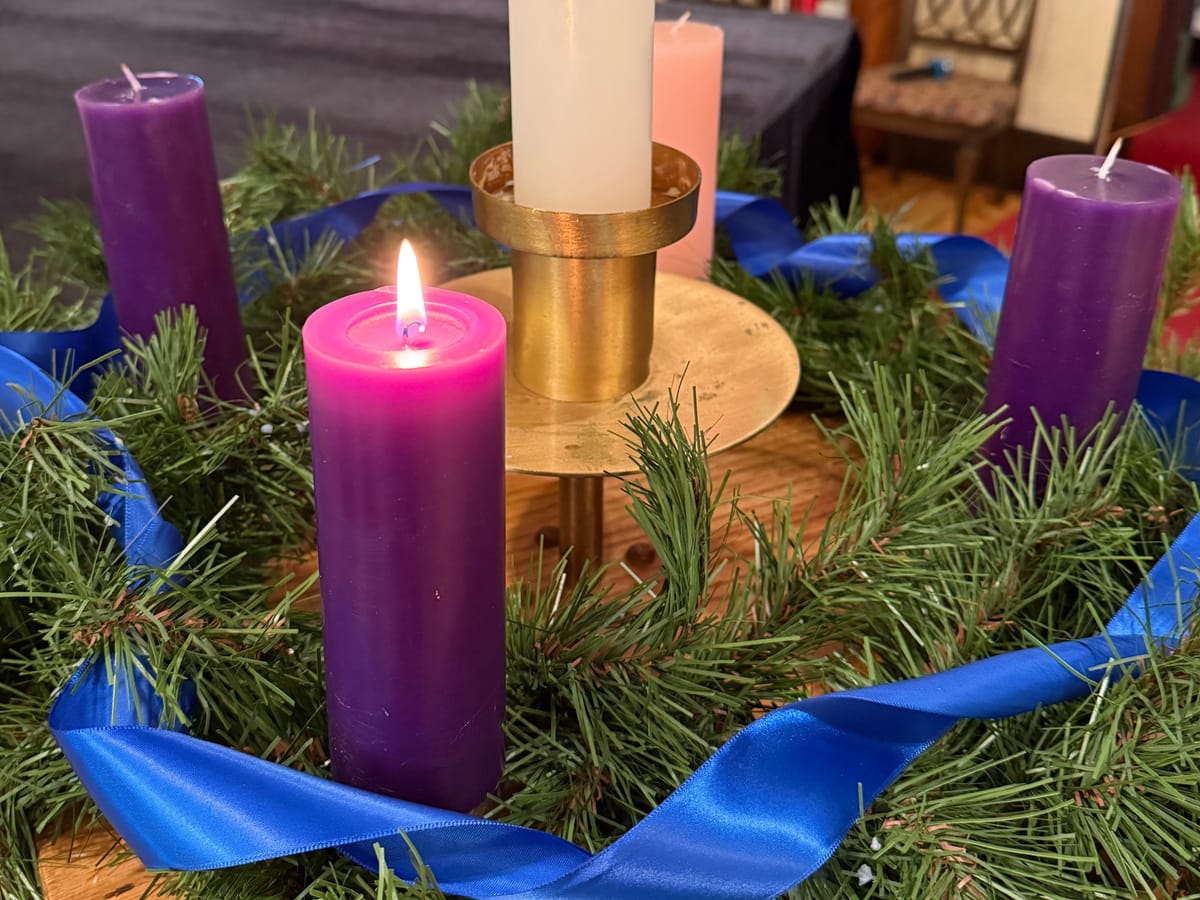
Again, that may sound bleak, like a message inappropriate for the festive holiday season, so if you’re still with me, let me decorate this tree with lights and ornaments and a big box of hope. There are some things we do know. The theme for the first week of Advent, as you might know, as the girls read at the beginning of service, the theme for us is hope.
We do know, thanks to the Isaiah reading today, that when the end of the world comes, whatever and whenever that may be, it will be a good end. “The nations shall beat their swords into ploughshares and their spears into pruning-hooks, nation shall not lift up sword against nation, neither shall they learn war any more... let us walk in the light of the Lord.” We long for, we hope for that sort of ending.
And, we do know that we are better off being fully awake, acknowledging that the ends will come, the world’s end and our own end, even if we don’t know when. We are better off acknowledging that than sleepwalking through our lives. If we hope and know that at the end we will be with Jesus, we know how to live in light of that hope. We know to put on the armor of Light, as it says in Romans, we know to love and live honorably, we know to live fully conscious of and awake to all the needs around us. We know to love.
Friends, Advent is a time of waiting, yes, but we need not be asleep while we wait. We know how to live in light of all that is to come, both personally, with our own endings, and cosmically, with the end of the world as we know it. We live in love. We live full of hope for the future, radiant so all may be hopeful too. And we live wearing the armor of light in a world of darkness, waiting for the true light of Christ to banish that darkness.
And that light is truly something to be thankful for.
Amen.