So So So So So So Much
If this God loves us so much to give us his Son, is there anything God will not do? Who can separate us from this love? Our God loves us so, so much.


The Ninth Sunday after Pentecost, Year A
Sermon for July 26, 2026
My friends, I speak to you today in the name of one God: Father, Son, and Holy Spirit. Amen. Please be seated.
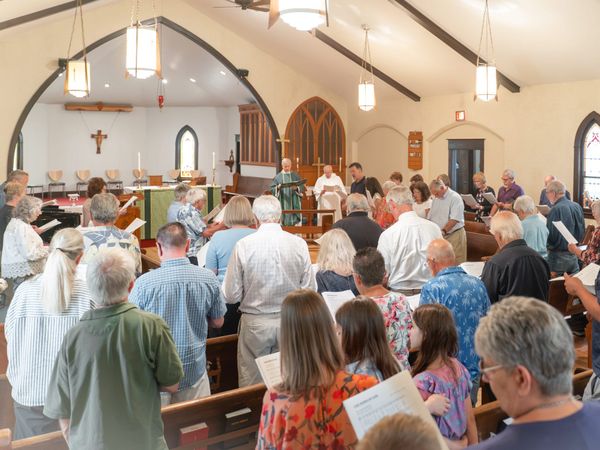
Good morning, Church of the Epiphany. Happy birthday today to Nora, our 8-year-old… she asked that we not sing to her this morning, but we’ll see. It has been another packed weekend here in South Haven, probably the most people I’ve seen in town in 2026. I cannot blame anyone for visiting this time of year; if you’re new this morning, welcome.
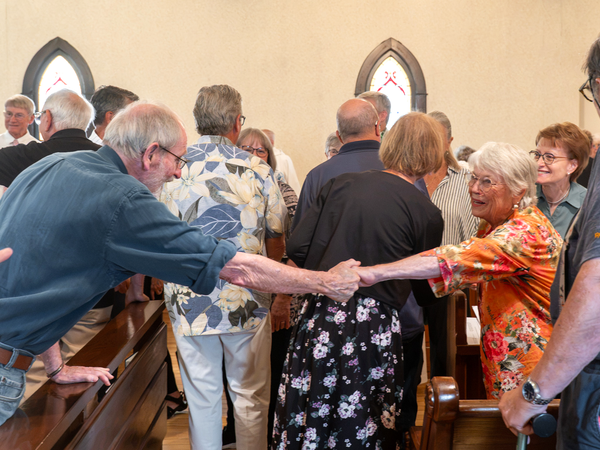
If you’re a visitor too, know that we have spent the past few weeks talking about Jesus and his parables. This is not a sermon series, just what our lectionary gives us: Matthew 13 is full of parables. We started with the Parable of the Sower, where we talked about spreading seed recklessly, loving without concern about the condition of the soil. We followed that last week with the Parable of the Wheat and the Weeds, where we learned that we’re all in this together, that it is not our job to worry about separating the good from the bad, but simply to grow, to love, and especially to love the stranger in our midst.
And now this week, we are given mustard seed, yeast, treasure hidden in a field, a merchant in search of pearls, and a net thrown in the sea and full of fish. Five parables, Jesus gives us five metaphors about the kingdom of heaven. So, this morning, I have five sermons to preach. My sermons average about 13 minutes each, so by my elementary school math, I have about an hour of preaching for you this morning. Are you ready?
No, thankfully for all of us, though each parable is deeply preachable and I’m sure you have heard good sermons on many of them, thankfully, in the last lines of the lectionary gospel this morning, we read Jesus asking the simple question: “Have you understood all this?” Those gathered answer, “Yes.” So, good, I assume it’s the same for you, you understand all five of these parables without any more preaching needed, so… I guess I’m done here.
Instead of preaching from the gospel text this morning, I’ll leave those parables for the next time they come up, instead, I think we need to take a closer look at Romans, at the text Anne read for us just a few minutes ago. We don’t dive into the Epistles, the letters to the churches, we don’t dive into the second reading of our services very often, but today we will. Not unlike today’s gospel, this passage of scripture has so much to say. It has so many phrases that resonate, so many theological questions and assertions.
In reading this passage of Paul’s letter to the church in Rome, we need to begin with the elephant in the room of “predestination,” of being God’s elect, so that we can usher that elephant out and get on with it. I won’t dive too much into this often-misunderstood point of theological debate; there are entire seminary classes, entire church denominations built on readings of it.
But for us, today, I ask you to read the idea of being “predestined” as being those whom God foreknew, those whom God loves. For us, as we read the entirety of the New Testament, we know that there is no one outside of that circle, no exceptions, no one left in the “God does not love them” portion of the Venn diagram. So, if you have a church background that tells you some are elect (often the ones in power) and that some are not elect, some are outside of God’s love, I ask this morning that you usher that predestination elephant out of your living room. Leave it in the backyard. Let it go.
Now, with that distinction made, we instead approach a Romans text that should be full of compassion, full of encouragement for all of us this morning, just as it was for the church in Rome. The first paragraph talks about an understanding of divinity that “helps us in our weakness” that intercedes on our behalf “with sighs too deep for words.” I love this language; you cannot read it without imagining the Spirit as a friend alongside us in our difficulties. Our Searching Spirits group read a book called When Things Fall Apart this month; it can be difficult to know how to pray and what to pray for when things are falling apart. Here, we are assured, that the Spirit is still with us in these, in all, moments.
And God, who searches the heart according to Paul, God and the Spirit are one: God knows the mind of the Spirit, the Spirit intercedes for the saints according to God’s will. God is not, as much of Rome believed in the first century, a distant, far-off force, but a personal, relational God, searching our hearts, deeply familiar with us and with our needs, deeply knowable through the Jewish tradition, through the life and death of Jesus, now through the Spirit. This one, true, triune God cares about us.
We as the church affirm this every week when we read the Nicene Creed: when we call God “the Father, the Almighty,” we assert that God is as close as a parent can be to each of us, not a watchmaker, not formless, nor an unknowable universe, but deeply personal, deeply relational, not only powerful and omnipotent, almighty. This is one of the attributes of God that makes Christianity so distinct in our world today: God is personal, relational.
I mentioned earlier that today is our daughter Nora’s 8th birthday. I believe Lily started the trend, which her sisters have also picked up, of making homemade cards for every celebration: every Father’s Day, Mother’s Day, every birthday. Jane and Nora have recently started shopping for those cards that make noise when you open them; do you know those, they play songs until you close them? But even when they buy those, they fill them with homemade notes. Homemade cards fill our house. I have a few in every room, some in the office here too. I share this because, for the last year or three, as Nora and Jane have begun really learning to read and write with confidence, they have landed on a steady, consistent message inside their cards. Each time, no matter who in our family is receiving the card, it reads something like this: “You are the best. I love you so so so so so so much.” And that’s it. The message of course is surrounded by doodles, by hearts, and the number of “so”s is often dependent on the size of the page: my Father’s Day card from Nora this year had 38 “so”s. I love you so so so so so… 38 times… so so much.
Their love for their parents, of course, pales in comparison to the love Abbey and I have for them. Many of you know what this is like, our family is not unique; the amount of love you have for your children, no matter how fraught or distant your relationship may be today, your love for your children has no limits. If you do not have children, your love for family, your love your parents had for you, even if they did not always show it, at one time it had no bounds. There is nothing like the love of a family, though I think we often come close here at Epiphany. I do not know how Catholic clergy lead, teach, or even survive without this sort of familial love, though I know they do. I know that I could not.
It is this sort of familial love, Paul writes, that God has for us. Paul was not in elementary school, the letter to the Romans was not a homemade card full of doodles, but after writing about a Spirit who intercedes for us with deep sighs, after writing about all things working together for good, after writing about predestination, justification, glorification, Paul writes: “What then are we to say?” “If this God is for us, who can be against us?” If this God loves us so much to give us his Son, is there anything this God will not do? Who can separate us from this kind of love? Our God loves us so so so so so so so so much.
Paul goes on a homiletical run here, I envision a Martin Luther King Jr. style address, fitting for a Baptist pulpit: Will hardship, or distress, or persecution, or famine, or nakedness, or peril, or sword separate us from this love? I’ll add a few for us: will sickness, or poverty, or frailty… will cancer, or a lack of recognition, or separation, or distance… will old age, or a difficult marriage, or corrupt governments, or frightening news, or anxiety about the future, or anything at all… will anything separate us from the love of our God? Paul strongly answers “no.” Paul lets the church in Rome know, he lets us know today, that God’s love is not distant or formless, it is that of a parent for a child, so close and so personal and so vast that nothing, nothing will separate us from it.
This morning, friends, Paul is sending us words of comfort for our anxious, frail, and broken world. Neither death, nor life, nor things present, nor things to come, nor angels, nor rulers, nor powers, nor height, nor depth, nor anything else in all creation will separate us from the love of God in Christ Jesus our Lord.
When we wonder what will become of us, when we face the difficulties of our lives, when we do not know how to pray as we ought, may we rest in the love of our God, the love of our Heavenly Father, Mother, Parent. May we all take refuge in a God who loves us so, so, so, so, so much.
Amen.