The Answer to the World’s Problems
We, as followers of Jesus, land here in these texts, in the Beatitudes, in 1 Corinthians, and in Micah: Do justice, love mercy, walk humbly with God.
Fourth Sunday after the Epiphany, Year A
Sermon for February 1, 2026
My friends, I speak to you today in the name of one God, Father, Son, and Holy Spirit. Amen. Please be seated.
Good morning, Epiphany. It’s good to be with you again this morning, in person, in real life. I spent most of the last week stuck in our home over on Parkview Lane: we had snow days, we had sick kids, our neighborhood roads weren’t plowed or salted. Our liturgy group even met at our house on Wednesday; my little Kia’s tires do not have quite as much traction as Ellen’s SUV. I felt a bit trapped this week, it was nice to see the roads again. So, it is good to be here with you this morning; after enjoying the Ice Breaker Festival yesterday, it feels like life here in South Haven is returning a little bit to normal.
Now, when you’re a priest somewhat confined to his home for a full week, you revert to old, pandemic-era practices, honed in the battles of the coronavirus of 2020. I spent more time on Zoom, on the phone, and on email this week than I care to think about. Zoom is my personal archnemesis, but I intend no offense to those tuning in via Zoom this morning! Our church in Charlotte, North Carolina, has met exclusively on Zoom for the last two weeks thanks to ice and snow down south… Zoom definitely has its place.
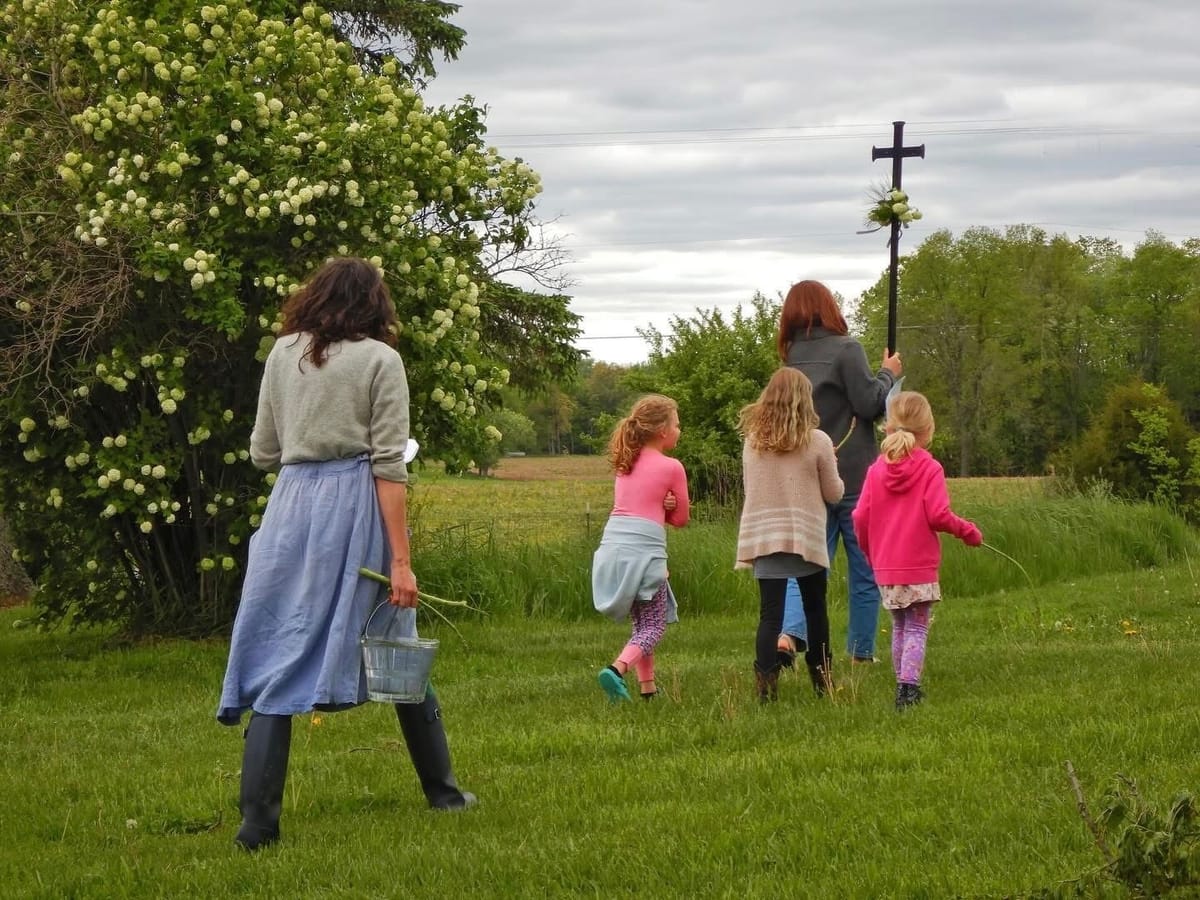
One of my Zoom meetings this week was with our friends up at Plainsong Farm, the ministry of “growing food and watching God growing people,” as they put it, the experiential, holistic ministry supported by our diocese. Several of us went up to Rockford, MI, last year for their “Blessing of the Fields” service, and their director, Emily Ulmer, came here to preach last August. Plainsong is a holy place, and they are holy people, doing good, good work on the farm. The Zoom call was essentially their “Winter Supporter Update,” a chance for them to update people on what it is that they’re up to. Their funding, donations have gone up, their volunteer numbers are up, and of course, with grocery prices also going up, the needs that they’re meeting are growing too.
During the call, Emily shared that one of their fellows (the Episcopal Service Corps volunteers who come for a full year) spoke at a local high school about the work that they do, and she shared this quote, which I want to pull and apply for us, here, today. Erin, the fellow, stood in front of a PowerPoint presentation with a photo of the main barn at the farm, and the quote was this: “This farm is not the answer to the world’s problems… but it is an interruption of its death-dealing systems… and an interruption toward the life-giving.” Let me repeat that: “This farm is not the answer to the world’s problems… but it is an interruption of its death-dealing systems, and an interruption toward the life-giving.”
I’m not sure what it was that spoke to me so strongly in that quote; perhaps it was just imagining hearing that as a high schooler and thinking it was “punk rock,” and in a good way, that’s a good thing. Perhaps it was the framing of a simple farm as “an interruption to death-dealing systems,” perhaps it was just the identification of the systems of our world as death-dealing that made me sit up and take notice. Perhaps it was that I needed to hear every simple action, every single act of courage, even working on a farm and planting a seed and growing just one real crop for someone to eat, that all these actions matter. Perhaps, in the light of the unraveling of societal fabric around us, I needed to hear some hope, that in this moment where action is necessary, each action counts.
Our Episcopal Bishops feel that way, our leadership here in this church, and 154 of them said so, strongly, in a six-minute video statement released to social media yesterday, I shared it on our Facebook page. A few of you sent it to me, and I’m glad you each did; I have printed copies of it available in the hallway for you to pick up and take home. Their statement, in the wake of ICE’s occupation of Minneapolis, in the wake of the deaths of Alex Pretti and Renee Good, calls us, in part, to action. In bold print, our bishops write, “We call on people of faith to stand by your values and act as your conscience demands.” They dive into some good detail on that in the statement, but they reiterate, “Every act of courage matters. We must keep showing up for one another. We are bound together because we are all made in the image of God. This begins with small, faithful steps.” Small, faithful steps; every act of courage matters. They also write, “This is a moment for action,” “In the face of fear, we choose hope,” and, “We cannot presume to speak for everyone or prescribe only one way to respond. For our part, we can only do as Jesus’ teaching shows us.”
So, Epiphany, what does Jesus’s teaching show us?
Friends, I am blessed as your priest with the opportunity to dive into what Jesus’s teaching shows us every single week, throughout the week, as my job. Now, I am not the only one who can spend time in the gospels throughout the week, let that be said, I encourage you all to do the same, but I get to do it, and for that I am exceedingly thankful. And, this week’s lectionary texts, all of them actually, they speak to this moment, to the Bishops’ call to do as Jesus’ teaching shows us to do, to what the Lord requires of us, to who is truly blessed.
We start with one of the most famous Old Testament passages, though you might not have realized it until the last few verses. “With what shall I come before the Lord,and bow myself before God on high?” Burnt offerings? Thousands of rams? Oil? My firstborn? How do I, a sinner, broken, how do I get right with God? The prophet Micah tells us, still today: “God has told you O mortal what is good,” what the Lord requires of us… Do justice. Love kindness. Walk humbly with your God. That is a bumper sticker if ever the Bible provides us one. It is a simple checklist, framed as action items, three simple tasks for anyone hoping to be “good,” or to please God. Do justice. Love kindness. Walk humbly with your God. When it comes to a moment for action, we must start there.
1 Corinthians continues the lessons for us today; this is one of the rare weeks when I really could just let the three scripture texts be the entire sermon. Paul tells the church in Corinth that “God has made foolish the wisdom of the world,” that “we proclaim Christ crucified…,” for this sort of love, as I preached about last week, this sort of sacrificial, unending love, this is true power, it is the power and the wisdom of God. If you are not loving like Christ, if you are searching out some other source of wisdom or power, I mean, alright, go for it, I guess, but this is the good stuff, right here, this love of Christ.
And finally, of course, we have the gospel, Matthew 5:1-12, the beginning of the Sermon on the Mount, Matthew’s three chapters of Jesus’s teaching that in the end, at the end of Matthew 7, leaves the crowds “astounded at his teaching.” I fear that I’ve said this before about a different passage, so I’ll give it a qualifier, but the Sermon on the Mount is my favorite passage in all of scripture (probably). We’ll spend next week in it too, which is simply not enough, but it’s how the calendar falls this year. If you want your faith to inform your response to the world as you’re living in it and not have your response formed by angry media sources that profit from keeping you angry and addicted to their newsletters, I invite you to read Matthew 5-7 every morning when you wake up. Please. If you need a copy of it, take the Bible in front of you in the pew, take it home with you.
Here in the first twelve verses of chapter five, we have the Beatitudes, we have what has been called the foundation of the upside-down kingdom, though if we’re honest, this is the right-way-up, and everything around us is upside-down. Blessed are the poor in spirit, those who mourn, the meek; blessed are those who hunger and thirst for righteousness; blessed are the merciful, the pure in heart, the peacemakers. Blessed are those who are persecuted for the sake of righteousness; blessed are you when people revile you and persecute you and utter evil against you falsely on account of Jesus. In America, at least for its first 250 years, we don’t face as much of the latter, persecution because of our faith, we don’t face as much as Christians do elsewhere, or as Christ’s followers did back in his time. But emphasizing a life of mercy, of peace, blessing those who mourn, the meek, this is the kingdom of God. This is where blessing falls, not on the wealthy, or the strong, not on the violent or the triumphant in battle, but here. Let these be the values that provide the foundation of your response to everything you encounter in this world.
Friends, the gospel, our faith, it is clear. Jesus’s teachings, they are clear. Though some may warp them for their own ends, or make this all simply a personal thing between our souls and God above for some day after we die… we cannot read the lectionary each week, we cannot go through the entirety of our scripture and tradition and reason and then land on abuse of the poor, abuse of any migrant, with or without papers, and we surely cannot land on murder of those we deem lawbreakers. We cannot even land on enforcement of the law as the chief foundation of society, as some today are claiming, as if that were really what was happening in Minnesota this last month. We, as Christians, as Episcopalians, as followers of Jesus, we land here, in these texts, in the Beatitudes, in 1 Corinthians, and in Micah 6:8: Do justice, love mercy, walk humbly with God.
And this is a different vision of the world that we are called to, we must admit. This has nothing to do with power or money or weapons or force or even votes. We are called, no matter who is in elected office, to live out God’s vision, God’s wisdom, and heaven’s joys, as we’ll sing about to close our service today. “Be thou my vision,” our vision, oh God. We are called, each of us, individually and collectively, to this different way of being; we are called to small, faithful steps; we are called to follow Jesus’s teachings; we are called to remember that every act of courage matters.
This vision is the interruption to death-dealing systems that the world longs for, this wisdom is our own interruption toward the life-giving. And friends, though that wonderful farm up in Rockford may not in itself be the answer to all the world’s problems, as they said in the Zoom call this week, the foundation it was built on is the answer. This calling we have today, the teaching about the kingdom of heaven, about who is truly blessed, about what is wise, about what is good, this is the answer to the world’s problems.
May we all choose to go and live into it.
Amen.