Unbelievable Love that Changes the World
In a moment of love so radical we cannot fully comprehend it, we now have “God with us.” The creator God is coming into the world to save the world.


Fourth Sunday of Advent, Year A
Sermon for December 21, 2025
My friends, I speak to you today in the name of one God, Father, Son, and Holy Spirit. Amen. Please be seated.
Good morning, Epiphany. I want to start my sermon today with a word of thanks. Two weeks ago, I let everyone in on a little health problem I’ve been having here as your priest in the season of Advent. That health problem, high blood pressure caused by stress, diet, and a lack of exercise, it is mostly under control now, we think. I’ve tried a few different medications whose side effects have not been fun, but I feel a bit better today than I did two weeks ago. I have also been overwhelmed by your response: probably 90% of this church is on blood pressure medications, of which I’ve heard a bunch of different names, and so many of you love your doctors, who almost universally are not taking new patients. (Ha.) Your vestry and I discussed self-care, both theirs and mine, and proper boundaries, and the retired clergy in the building assured me they could help if I was ever feeling overworked. Someone even gifted me a wellness club membership. Thank you.
What I felt these last two weeks could be defined correctly as “love.” And the theme of this fourth week of Advent, according to the last century or two of ecumenical, pastoral tradition, is love, following hope, peace, and joy, which Pastor Bob preached about last week, anticipatory joy. On occasion, those Advent themes have been difficult to find in the lectionary readings assigned to these weeks, but this week, love, well it is all over the gospel. We’ll get to this story, this Christmas prelude in a minute.
But what I wanted to first ask instead is a simple question... or maybe it’s not so simple. This question might be familiar to you, I know some of our most beloved authors and philosophers have posed answers to it. The question is this: What is the opposite of love?
Hold on to your answer for me. What is the opposite of love? I’ll be asking this again.
I first ran into this question during my time in Seattle, in grad school when I was learning to be a therapist. Some of you said last week that you never would have expected I had anxiety, that I seemed so peaceful in our conversations... well, that is entirely thanks to the well-practiced “non-anxious presence” I learned in grad school. The Seattle School of Theology and Psychology had a reputation for being Christian yet wildly liberal, even for Seattle, and my evangelical, midwest brain wasn’t entirely ready for all of it. (We did have our big services, graduation and the like, at St. Mark’s Episcopal Cathedral in Seattle, so that was my first brush up with the tradition we’re all in today, thanks be to God.) We had a class at the Seattle School required for each incoming student, regardless of program, taught by school president Dan Allender called “Faith, Hope, and Love.”
As we discussed love, so many of the things I learned in that class still stick with me, but this, from the middle of a lecture in 2008, was particularly impactful: “Love necessarily causes change. The price of love is that people don’t always respond with repentance or reconciliation. And so, love creates a heart that suffers. Are you ready to suffer for love?”
I ask again, what is the opposite of love?
A popular passage from the Bible defines love for us slightly differently: 1 Corinthians 13, known especially at weddings as the love chapter. There we learn that “Love is patient; love is kind; it is not envious or boastful or arrogant or rude. It does not insist on its own way; it is not irritable; it keeps no record of wrongs; love does not rejoice in wrongdoing but rejoices in the truth. Love bears all things, believes all things, hopes all things, endures all things. Love never ends.”
So, again, what is the opposite of love?
I have five good answers here in front of me, but I feel like I’ve given you all enough time with it, so I’m curious, if you’ve thought about this before... what is the opposite of love? Anyone willing to give an answer? ... Hate (Dictionary). Fear (1 John, Elizabeth Kubler-Ross, Yoko Ono). Selfishness (Pope Francis, Bishop Curry.) Avoidance (Alain de Botton). Apathy/Indifference (Elie Wiesel). Probably a few others... (Sorrow, Loneliness were both offered)
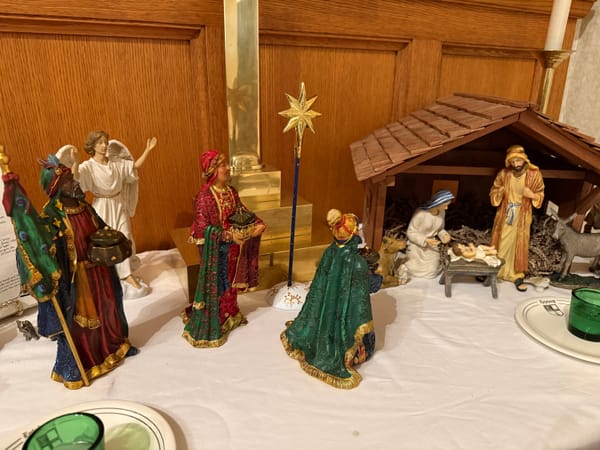
I ask this question in light of our gospel reading today, which, admittedly, if you’re reading it through Mary’s eyes, might be a little difficult to bear. The Gospel of Matthew begins with the genealogy of Jesus; the New Testament begins with this genesis of Jesus. The first 17 verses of Matthew track 42 generations back from Jesus through David and Solomon to Abraham, Isaac, and Jacob, including most of the main characters of Hebrew scriptures, of our Old Testament, most of them men. Verses 18-25 then, which we have today, these verses continue that trend, focusing on the man’s role, Joseph’s role, in our familiar Christmas story, a story that is thankfully built out quite a bit more in the gospel of Luke, lest our nativity scenes suffer from a lack of mangers, shepherds, and animals.
In this text, we are told of a young, engaged couple, Joseph and Mary, who found out she was pregnant before they lived together. There’s some helpful context here: that Jewish engagements were serious business and required a divorce to end them, that “before they lived together” is true but also kind of a code for the thing couples do on their wedding night. So we know that this birth was impossible, medically and logistically, and that Joseph, “being a righteous man,” which I think is true and important and not cynical or sarcastic, this righteous man was hoping to shield his beloved from the disgrace of her infidelity as best he could. I think some of us could get caught up on this part of the story, thinking through our 21st century, American lenses, that Joseph is simply discarding her, and that does not feel very loving. I really don’t think that’s the case; he is framed in the telling here as a righteous man. Regardless, it’s an unfortunate situation for everyone.
But thankfully, this story is not solely about a righteous Joseph, or even Mary, nor is it about the angel that appears in a dream. This story, it is about Emmanuel: God with us.
This familiar story tells us that Mary is about to give birth to a son, who they are to name Jesus (or Yeshua, which means God saves) for this baby boy will save his people from their sins. Joseph surely must have been incredulous, just as Mary is in the first chapter of the Gospel of Luke, but both of them pushed through their fear, their anxiety, their concern for their own future and said yes to an angel. “Here am I, a servant of the Lord.”
But really, this is a story about God, and about God’s love for us. We know from John 3:16 that “God so loved the world that he gave his only son, so that everyone who believes in him may not perish but may have eternal life.” God could have looked at the world, the messed up, broken world, and sent another flood. There are stories throughout the Old Testament of a God who is about on the edge of giving up on it all. But instead, in a moment of love so radical we cannot fully comprehend it, we now have “God is with us.” The creator God is going to come into the world to save the world. Jesus, Emmanuel.
Friends, the opposite of love question was intended this morning to give us all a broader viewpoint on love as we enter this last week of Advent. We talk about love a lot around here – love God, love your neighbor – and we do it well, exceptionally well. But we also know that love means a lot more than welcome and kindness and a shared meal after church, though that is certainly a wonderful foundation, an introduction, a necessary and beautiful beginning. But love can be easy when things are going well, in a church like ours or in a first-century relationship. And life is not always easy. “Love necessarily causes change... love creates a heart that suffers. Are you ready to suffer for love?”
God was ready to suffer for love, as we know, and not just in a brutal crucifixion, but in the daily pains of being human. God loves us enough to be fully with us. Are we ready to suffer?
If the opposite of love, as we understand it, is hate, fear, selfishness, avoidance, apathy, indifference... then love requires courage. Love requires action, not apathy. Love requires commitment, sustained commitment. Love requires faithful and open presence in the midst of conflict. Love requires us to lay down selfish desires for the sake of the other. Love requires us to let go of what others may think of us, to suffer, to change, and to boldly move into the Way, into following this Jesus who we will fully celebrate coming into the world later this week.
And we can choose that way of love because our God unbelievably, radically, loves us and will help us all along the way. God chooses to be with us here in this world, two thousand years ago as an unbelievable baby borne to a virgin, and yes, here this morning and in our lives today too. God still chooses to be with us.
In this familiar, memorable gospel text this morning, we learn that our God is an awesome God, one of unbelievable, radical, world-changing love, who chooses to be with us in unbelievable ways. May we, God’s people, strive today, this week, this next year, to live in that same unbelievable love. And may we all be filled with a love so overflowing that it spills out from us and helps bring about God’s kingdom, throughout the world, all around us.
Amen.