When I Look at the Stars
God is bigger than any boundary, so our sole task is to cure our divine deficit disorder, to let God and love be the foundation for everything else.
My friends, I speak to you today in the name of one God: Father, Son, and Holy Spirit. Amen. Please be seated.
Good morning, Church of the Epiphany. It’s good to be back with you again this week. Last week, Pastor Bob preached, presided, and baptized; I stayed home with a recovering wife. Abbey’s surgery went well, just don’t hug her too tightly today, please. Missing last week, and Abbey’s surgery in general, threw me (and our household) out of rhythm a bit. As I’ve said before here and as I know many of you feel, my entire week feels better when we start it together, with our God, here on Sunday morning. It’s almost like there’s a reason or two the church has met weekly for centuries. Again, it’s good to be back.
This last week, while I was out of rhythm, was the peak of one of my dad’s favorite events, something I remember learning about and experiencing as a kid in the dark, rural, farmlands of Michigan when we’d visit this beautiful state on vacation every summer. That event is the Perseids meteor shower. For those who’ve never heard of this, maybe astronomy isn’t your thing, that’s okay. This annual meteor shower comes every August, it’s visible best before the dawn, and according to NASA, it involves pieces of space debris interacting with our atmosphere, debris that originates from a comet discovered in 1862. The Swift-Tuttle comet is about 16 miles across, about twice the size of the object that likely led to the demise of the dinosaurs. It missed earth, thankfully, but its’ debris falls into our atmosphere annually, and it appears to come from a point in the sky near the constellation Perseus, though that’s not the actual source, it’s comet debris. The Perseids meteors are known for their fireballs, explosions of light and color, that persist longer than an average meteor streak, and there can be as many as 50-100 seen per hour.
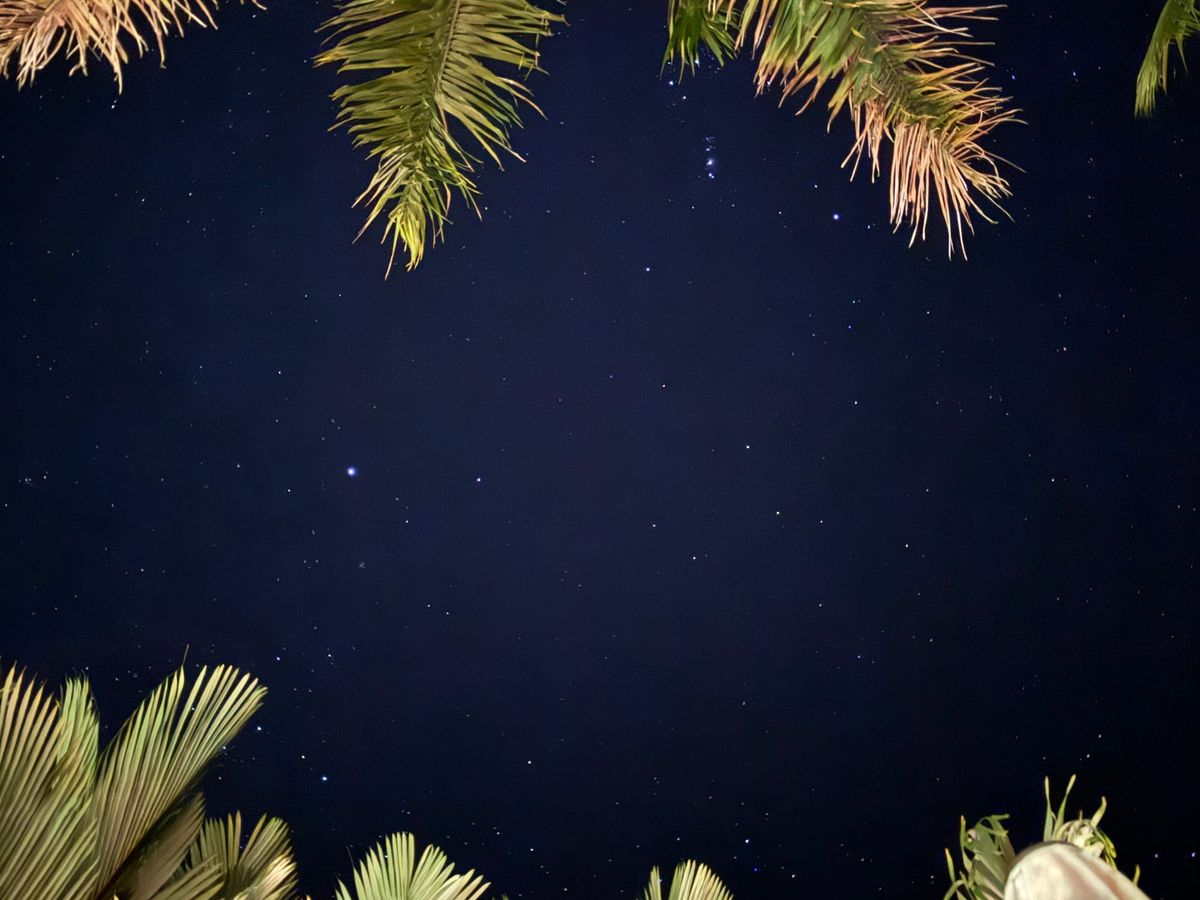
Around 11 pm last Wednesday night – the peak night, according to the calendars at least – Lily, Grandpa, and I sat out in the driveway staring at the sky, hoping to see a meteor or two. Taking that time together, three generations of our family just sitting and staring into space, is always a good and important thing, but I am certain that if our neighbors saw us, they would have thought that we were crazy. Imagine seeing three people sitting in lawn chairs staring into space at 11 pm… now imagine that if you didn’t know there was a meteor shower going on. You’d think they were nuts, or something else. I’m reminded of the slogan from the Ted Lasso show, “Be Curious, Not Judgmental”; hopefully if our neighbors did see us, they’d be curious as to why we were out there and not judgmental.
So, we sat in the driveway at 11 pm, and we only saw one meteor before the fog and clouds rolled in, ending the night. Lily wanted to go back out later, but the weather did not agree with us, and the cloud cover was worse on Thursday night. Maybe next year.
But why this story about the Perseids meteor shower? We have two incredible gospel stories this morning, two stories with plenty to teach from and discuss, why are we talking about staring up at the stars? Let’s go to those gospel stories, see what we find.
In the first paragraph, the first story with the crowd, the first “pericope” as we learned to call them in seminary, we have Jesus teaching a seemingly simple point to those obsessed with following the law down to the letter. The Pharisees are those who have equated their faith in God with following every piece of the law, and Jesus equates them with the blind leading the blind, which is just a helluva metaphor. Jesus says that, instead, it is not about what goes into your mouth, but what comes out of it, that’s what defiles you. Jesus is teaching them that their law-following intentions may be good, but they lack a divine understanding of the world, they’re still caught in the “follow the rules, get rewarded” sort of game, and their hearts are not in the right place. Unwashed hands do not defile you, eating the wrong thing, does not defile you, but living without the love of God in your heart, the love that we know changes every interaction, that’s what holds you back.
The second pericope, paired with the first, is perhaps even more memorable, more worthy of examination. A Canaanite woman comes to this Jewish Messiah and shouts at him, “Have mercy on me Lord, Son of David, my daughter is tormented by a demon.” Jesus gives her the silent treatment: he “does not answer her at all.” His disciples are over it, tired of the yelling, and they ask him to send her away, and he answers her “I’m not here for you, I’m here for the Jews, sent only to the lost sheep of Israel.” There’s debate about how we should interpret the rest of this, the second incredible metaphor in our lectionary text today: “It is not fair to take the children’s food and throw it to the dogs,” he says. She answers, “Yes, but even the dogs eat the crumbs that fall from the masters table.” Jesus, our Lord and Savior, calls a needy woman a dog. Surely not! Maybe this is “one of those passages Matthew added”, right? “Our Jesus wouldn’t say that.” Or maybe he did, maybe he was as biased and prejudiced as his disciples, and he needed to learn from this witty Canaanite woman, learn that he wasn’t just here for the lost sheep. Jesus needed to learn.
Both of those (denial, learning) are popular explanations of this text, but I personally land on a third option, that Jesus needed the disciples (and us) to see just how silly and unacceptable any sort of bias and prejudice really is when it comes to God. Whether the woman was in on this teaching moment or not, Jesus, being God himself, has the divine vision. He knows here and in chapters before this, that his mission is God’s mission, one of redeeming the entire world. Here, I think Jesus needed the disciples (and us) to be confronted with the harshness and the cruelty of keeping healing and love from some and giving it only to a select few. Because that’s not what God does: there are no checklists, no bloodlines, no rulebooks, no gatekeepers when it comes to the abundant love of God.
This was radical teaching for first century Jews; it is radical teaching still today. Then, we had Pharisees and Sadducees and specific laws about what you could eat and drink; following those laws to the letter is what earned you the kingdom, what gave you favor in the sight of God. That said, only those who knew those laws could follow them, only the Jews, the select few, could possibly be saved by their Messiah, could come into right relationship with God. So, of course, this led to prejudice and bias and mistreatment of those outside their circles. When you create and live by a system where some are in and some are out, you invite insult, violence, and mistreatment, every time. Those with ears to hear, let them hear.
But Jesus knew better then, he knows better today. Jesus pointed not to law, but to the heart, to our ability to see by and live according to God’s vision for the world, where all are loved, all are worthy. Jesus affirms the faith of one outside the circle, one whom the disciples wanted sent away, and he affirms it for all to see. He will be a Messiah not to be reserved for one small group of rule followers in the ancient Middle East, but a Savior for us all, the Son of a God who is bigger than nationality or race, bigger than religion or creed, bigger than anything we can possibly construct to describe God, though we do try.
Christianity is at its best, I think, when we leave room for silence and awe in the face of the Holy, when we worship through ritual, liturgy, knowing we don’t know everything, when we simply try to catch the divine vision for the world, when we then try to construct a world that points us simply toward loving God and loving our neighbor. Christianity does not always do that. We are all human, and we like to fill silent pauses with set answers to our deepest questions; we tend to create laws to follow rather than simply following the Holy One. But we know, from texts like these, that God is bigger than any religious boundary, and that our sole task is to cure our divine deficit disorder, to plunge into the heartbeat of God, to let God and love be the foundations for everything else.
One way many of us try to catch that divine vision of the world, to sit with the God of the universe, is by showing up here, at church. Sadly, we only do this, what, about an hour each week?
So how else do you make space for the Holy? Do you?
We all need to find more ways. Maybe you could take time to hear the birdsong, to watch the waves, to listen to the snowfall, maybe take time to sit in your driveway and look at the stars, to sit in awe of all that is around us. If nature doesn’t do it for you, that’s okay, maybe you could take time to serve those in need, maybe at Pullman, maybe with WeCare, or take time to be in community, to truly care for those around you, maybe even at brunch. Find more ways to be drawn into God’s presence, not consumed by schedules and to-do lists, not overrun by health or financial concerns, not overwhelmed by angst about our looming political and environmental disasters. Find time, hold space, to be caught up in the divine vision, to consider God, to sit with the love of our creator that gives us each and every breath.
Our neighbors may think we are crazy for sitting in our driveways at 11 pm or for going to church every Sunday morning, but maybe they’ll be curious about it, not judgmental. Regardless, for us this morning, any time we spend with a God who is bigger than any division, who refuses to reserve love for a select few but shares it abundantly with all, any time we spend with a God who is infinitely bigger than all the stars and meteors in the sky, that time will change our lives and change our world.
Amen.