So Much More Can Be Mended
If Peter can be mended after his denials and despair, if the gap between us and God can be mended, surely too will our broken world be. Are you ready?

Easter Sunday, Year A
Sermon for April 5, 2026
My friends, I speak to you today in the name of one God, Father, Son, and Holy Spirit. Amen. Please be seated.
Happy Easter, Church of the Epiphany! It’s so good, especially good to be with you this morning. After weeks of Lenten sermons, sermons touching on death, on difficulty; it was unbelievably good to sit down for this one and write, “He is Risen.” We have desperately needed Easter around here; we need Easter everywhere, every year, but this year that feels especially true. And this morning, we have it: Resurrection Sunday, the joy of the empty tomb, all the alleluias, all the singing, all the flowers, all the light (at least inside) today. “I have seen the Lord!” Mary Magdalene announced, and so do we.
If you’ll remember from last year, I like to start my Easter sermon with a joke, and so I’ll do it again this year. Last year, I asked you to “give Peeps a chance.” This year, a simple question: Where does the Easter Bunny like to eat breakfast? At IHOP, of course……
I tell a joke on Easter because today is a day for joy, for laughter. This is the day we are reminded that our story is a dramatic comedy, not a tragedy, meaning that despite all the difficulty of this life, despite all the difficulty we see around us, there is indeed a happy ending. Sin, death, they are not the final word. Love, resurrection, they win. Love wins.
This morning, the story is what we read from the gospel of John: the very personification of goodness and love, the holy Son of God who was crucified on the cross, he has risen from the dead and he is Lord. The powers of the world, those who rule with strength, force, and power, those who hold tight to their rule through fear, those who embrace greed and ambition, they put Jesus to death in the most brutal way we can imagine while his friends and family and all of Jerusalem looked on in horror. Those friends, still caring for him after his death, are astonished to find the stone rolled away today. They were there at the foot of the cross, weeping; they are here today to see that death does not win.
I am struck this morning, this year, by these friends of Jesus, the ones who have borne witness to the most emotional roller coaster imaginable, one that involved the last supper, overnight prayer in a garden, an arrest, a sham trial, torture, execution, fear for their own lives, and now, this morning, confusion, new belief, and joy. Shock at the death of a friend is one thing; the disciples, Mary Magdalene, they have been through many things.
We don’t get the full story of Easter in this one morning service, that takes a few weeks actually, with the Great 50 Days of Easter, a season we celebrate through Pentecost Sunday, seven weeks from now. But through these seven weeks, through the final chapters of John and the other gospels, we see these friends and their reactions to this miraculous event. Some are initially skeptical, others easily and readily believe; some get the cosmic implications, others are more concerned with personal ones. Sounds familiar.
For Peter, in particular, this story has personal importance. We read this morning that after Mary Magdalene told them the tomb was empty, he and John ran to the tomb, and leaving John outside, Peter entered the tomb first, seeing the linen wrappings and cloth, but no body. Peter, the one who had denied Jesus three times during his trial, the one who fled and is not mentioned during the crucifixion, Peter runs to the tomb to find it empty.
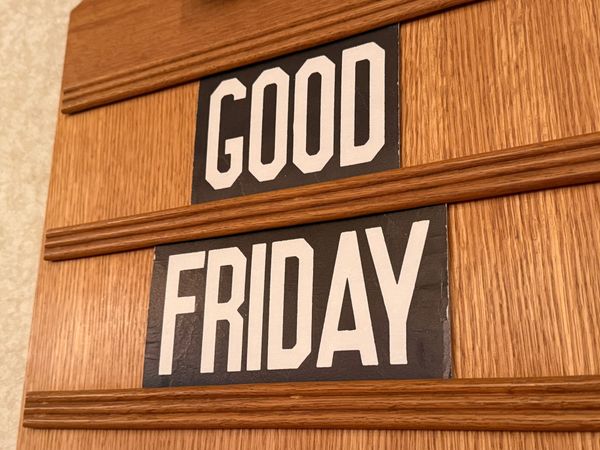
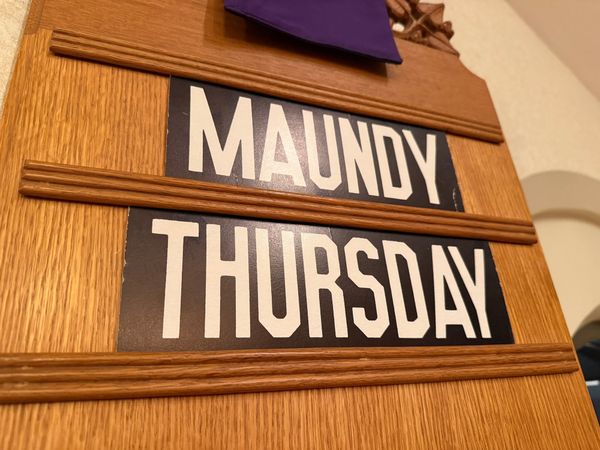
The structure and tradition of our Holy Week observances allow us to experience again the last supper, the breaking of bread and the washing of feet, followed by the prayer in the garden, and the Passion narrative, the arrest, the trial, all the way through to the crucifixion. That narrative arc always includes Peter’s denials on Good Friday. And then, we are given Holy Saturday, yesterday, to sit in the despair between the cross and this morning, the empty tomb. I think that part is hardest to sit with, for many reasons; it’s not as emotionally difficult maybe, but logistically. How do we experience despair when we know there is a happy ending? Try to put yourself in the shoes of those who had given up everything to follow Jesus only to have him named an enemy of the state, only to see him die and everything you had come to believe in fall apart, and then sit in that for a full day, a day when our world is full of spring, of Easter bunnies and candy. It is not easy to do.
Peter though, on his Holy Saturday, he must have been devastated. He had failed his final vow to his beloved Jesus, the vow that Jesus knew he would never keep; he denied Jesus three times before the rooster crowed. Peter then fled the scene, not even witnessing the crucifixion, not there to hear Jesus’s last words. He was a coward, a terrible friend. On Saturday, all of their despair would have been crushing, but Peter’s maybe especially so.
So, this morning, we read Peter running with John to the tomb. He’s a little slower than John, but that’s okay; he is the first inside, the first to see that Jesus had risen from the dead, that Jesus had defeated death. All of that despair, it begins to shift on that roller coaster of emotion, to confusion probably, to far more questions certainly, but also, hope. Hope now has a chance to let itself in through the cracks in his despair. What did someone preach here recently? “There is a crack in everything, that’s how the light gets in.”
In a world of despair, of self-doubt and self-loathing, in a world where the crushing power of an oppressive government is ruining and breaking and taking all that he loves, Peter gets a crack, a chance for hope in the darkness, a chance for some light to get in.
In the verses following this morning’s reading, following the Resurrection, Jesus meets with his disciples in the early morning, he appears to them on the beach while they are fishing, and we read that “when Simon Peter (sees) that it was the Lord,” he jumps straight into the water to get to him as fast as possible. Jesus, his friend, his teacher, he is there having defeated death, and Peter cannot wait to see him, to talk to him.
We don’t read this part in our lectionary this year, but after breakfast, Jesus asks Peter if he loves him, and he asks him this three times. Three times Peter says yes, reversing his three denials of Good Friday. Peter is ready now to live in the light of the resurrection, he is ready to let go of despair, doubt, failure, self-loathing. Jesus’s final command to Peter is simply, “Follow me.” From Acts and the history of the church, we know that he does.
So... why so much about Peter this morning? We see the empty tomb, we know Jesus is risen from the dead, we will celebrate it and sing many verses about it this morning, yes. But for Peter, and for us, this day was not just one more Sunday out of the year. It was a Sunday that changed everything. Easter is the day we fully learn what we begin to learn at Christmas, at Epiphany, that Jesus is no mere teacher, born to Mary, baptized by John. Jesus Christ defeats death itself, no tomb can hold him. Sin and hell have no power here.
I preached on Good Friday about a gap between us and God, one that first appears in our creation story, when sin enters the world and disrupts God’s very good creation. That gap begins to narrow, I believe, first with the incarnation, with God choosing to be with us… that gap narrows again with the crucifixion, with the Son of God selflessly loving, dying on the cross… and that gap closes completely and forever today with Easter, with the resurrection of Jesus Christ from the dead. The gap is closed with the defeat of sin, of death. The gap has been mended; it is no more. Today we celebrate not just a first-century man rising from the dead in Jerusalem, but the completion of Christ’s total victory. Hell is empty, sin has no hold on us, because Jesus has died and is risen. Alleluia.
For Peter, his brokenness, his despair, his failings, they are wiped away because of Easter. He has himself been mended too. English author Francis Spufford writes that the meaning and message of Easter is simply this: “Far more can be mended than you know.” Sounds like Tolkien or Lewis. "Far more can be mended that we know." If Peter can be mended after his denials and despair, if the gap between us and God can be mended, surely too will our broken world be.
So, friends, are you ready to leave your despair behind? Are you ready to let the hope in? And are you ready to be the light shining through the cracks? Are you ready to live in the light of an empty tomb, in the light of the resurrection?
Happy Easter.
Amen.