The Wages of Sin are Indeed Death
Sin is not indifferent nor neutral; it actively kills what is good. And tonight, we see sin killing Jesus, goodness and love personified.


My friends, I speak to you tonight in the name of one God, Father, Son, and Holy Spirit. Amen.
Good evening, Epiphany. Today is Good Friday, I don’t need to tell you that our service is a little different tonight, our rituals of worship are different. We read the Passion narrative again tonight; after entering Jerusalem in a parade, after breaking bread with his friends and washing their feet, after praying in the garden throughout the night, Jesus is now betrayed, arrested, put on trial, tortured, mocked, crucified, and laid in the tomb.
It’s appropriate that our service would feel different, weighty tonight, that the annual way we mark our faith, this annual service that marks us, that it would not be our usual joyful gathering. The tone tonight is solemn, penitential, sad, really. It is a heavy service.
I confessed this afternoon at our ecumenical Good Friday service over at Peace Lutheran that this day is overwhelming for me, it weighs heavily on me as your priest. I think it is overwhelming for many of us who engage it, and it probably should be, especially so thanks to some serious guilt and baggage that some traditions pour into it. There is a lot going on in this one narrative, there is a lot that affects our understanding of who Jesus is, and there is a lot going on cosmically, a lot that we cannot hope to fully understand.
Theologians have tried for centuries to put words to what happens on the cross. I know many in this room are repulsed by the idea that God would use Jesus as a ransom to the devil, or that a loving God would require a blood sacrifice, require the death of God’s own son to wash away our sins, but many Christians do land there, many at today’s ecumenical service landed there. The majority of American Christians land on sacrifice and ransom as their understanding of the crucifixion, and many throughout the world do, a few Episcopalians too. I won’t dive into all the many atonement theories tonight, because this is not a class, but I will say that ransom theory, penal substitution, those are not my favorite theories; I don’t think and I won’t preach that God’s justice somehow required Jesus’s bloody, awful, gruesome death.
What centuries of theologians might have in common, though, what we had in common at the ecumenical service today, is an understanding that what happens on the cross, what happens on Good Friday, somehow, mysteriously, works to bridge some sort of gap between us and God. I believe that “gap” is bridged primarily in the Incarnation, at Christmas, when God chooses to be with us in a truly unbelievable way. But there is undeniably something still special and important happening here, tonight, with the crucifixion, with Christ’s death. If there wasn’t something important here, the “cup would have been taken from him,” as Jesus asked his Father in the garden, and this story, our Savior’s brutal death, wouldn’t have taken place.
But it does. What are we to do with the death of Jesus, the death of the Son of God? How do we take this terrible story and make it make sense for us today? We’re not diving into Easter just yet. We’re here at the crucifixion, at the bloody, terrible story of Good Friday.
Well, there are a few verses in Romans that I find helpful when thinking about sin, so I turned there this week; Paul wasn’t afraid to talk about some of the more difficult questions of life. Even if we, in the twenty-first century, don’t all love where he landed in his first-century context, he’s worthy of plenty of consideration. In Romans 3, Paul talks about sin, writing, “For all have sinned and fall short of the glory of God; (we) are now justified by his grace as a gift, through the redemption that is in Christ Jesus.” This is a passage often cited by those who think of Jesus as a blood sacrifice; the next few verses talk about the crucifixion that way, using that language. But the word Paul uses for sin throughout, one way to think about it, is hamartia, which means, “missing the mark.”
There’s debate about why Paul chose that Greek term, but it’s commonly used in describing an archer’s inability to hit a bullseye. An archer tries but misses the target: hamartia. We all have “missed the mark,” then, and fallen short of the glory of God.
As we have said many times here over the last few years, it is difficult to look around us and not see a society “missing the mark,” a world with its priorities misaligned, with fear, greed, and worse leading the way from the highest halls of power to our own neighborhoods, even our own families. You would be hard-pressed to say that modern society has achieved the glory of God. We are very clearly falling short of it. And one thing the crucifixion shows us, in no uncertain terms, is that we are not the first to be missing the mark. We are not the first to hamartia; we are not the first to sin.
I am not saying that we are inherently sinful, though a few traditions do say that; we believe here that all that God created is good, very good, us included. But sin is real. Brokenness is real. “Missing the mark” of glory, that is certainly real. We see that all around us, we see it on the news, we see it in unjust wars, in families jailed and deported, in poverty, crime, sickness, in our own broken relationships. We do see sin all around us.
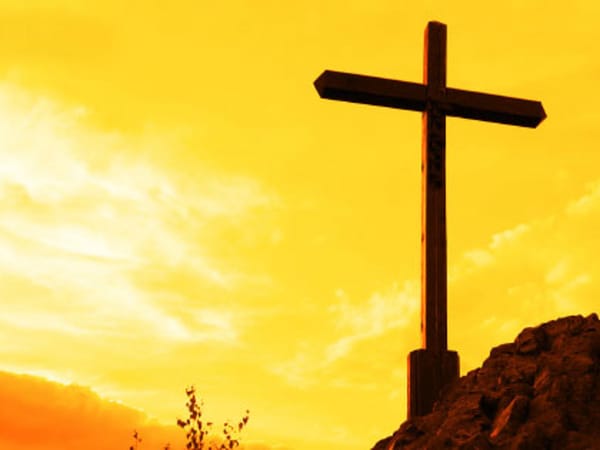
And the wages of sin is death. Paul writes that to the Romans too, saying, “For the wages of sin is death but the gift of God is eternal life in Christ.” From sin, from brokenness, comes death. The ways that we are missing the mark, the ways that the people of the first century missed the mark, those ways bring death. Our sin still today results in killing what is good in the world. Sin is not indifferent; it is not neutral; sin and brokenness actively kill what is good. And tonight, writ large, we see sin killing Jesus, Jesus who is goodness and love personified. Our sin, tonight, it kills the very Son of God.
Now there is a happy turn coming, as we hopefully know, on Sunday morning. Death is not the final word, and that gap I mentioned that needs to be bridged, I believe the bridging is finally completed this weekend. But tonight, we see Christ crucified. We see the gap beginning to narrow through this ultimate act of sacrificial, overwhelming, unbelievable love. God incarnate, Jesus Christ, he lays down his life for us on Good Friday… we can ask no more of anyone, we can aspire to no greater example, we can expect nothing more “Good” than that. But it was indeed sin and brokenness and greed and quests for power that put him there on that cross, that needed to kill what is good and whole and right and just and holy when it fully appeared, incarnate in our world.
Tonight, then, may we take some time, make some space, and spend it with sin. May we spend tomorrow considering the wages of sin too, before Easter Sunday amid the despair of Holy Saturday. May we recognize that our own sin is keeping us from goodness, wholeness, righteousness, and that our cultural and national sins are doing the same. May we ask for forgiveness and redemption from our sin; may we repent, turn away from it in pursuit of what is good, what is loving. And finally, may we be exceedingly thankful for God’s willingness to come to us, for a God who in every respect has been tested as we are, yet never let sin take hold of him. To continue to echo the author of the letter to the Hebrews, when we are truly thankful for this act of God we read about tonight, we can then approach God’s throne of grace with confidence, because we who are indeed sinners, are able to receive mercy and find forgiveness and look toward a future where sin no longer leads to death, but all sin is defeated.
Amen.