Joining in Humble Service, Mutual Love
I think we need to wash each other’s feet all the time, the entire church, the entire world. This may be the sacrament this world is deeply missing.
Maundy Thursday, Year A
Sermon for April 2, 2026
My friends, I speak to you tonight in the name of one God, Father, Son, and Holy Spirit. Amen. Please be seated.
Good evening, Epiphany. Welcome to Maundy Thursday 2026, our introduction into the Paschal (or Easter) Triduum, our fancy word for three services that all constitute one big service over the next three days. Some parishes put together one big bulletin for all three services and have you bring it back for Good Friday and for Easter, either a Saturday night vigil or for Sunday morning’s Resurrection service. Maybe we try that next year.
Tonight is the service where we read about rituals, about the Passover lamb in Exodus, about the bread and the wine, and yes, about the washing of each other’s feet. I preached about rituals last year on Maundy Thursday, about the fact that the rituals we perform, the habits we build, the ways we spend our time daily, weekly, monthly, yearly… these are not just an expression of who we are, but they also actively shape and change who we are too. We are what we love, what we do. These rituals, they mark time and they mark us.
This year, I’ll recognize aloud for those of you here that tonight’s ritual causes the most hesitation, the most cringing, of all our rituals in the church. Some traditions actually offer foot washing every Sunday. We do it once per year and many still opt out; some stay home, others here will likely stay in your pews, and that’s okay. I opted out for many years. Wherever you are on your journey of life and faith, right? All are welcome here.
As Westerners, Americans, we are often a fiercely individual people. We want to be self-sustaining, self-supporting. There are few among us who did not feel pressure to get a job, to move out of their parents’ house, to make their own way in the world. Rarely do we want to rely on others; asking for money from others takes an incredible amount of humility or desperation. Sadly, this often leads to an inability or a hesitation to serve and help others too. We pull ourselves up by our own boot-straps here – which is literally impossible even if we wore boots – and in turn, many expect others to do the same. So, the washing of feet, touching someone else’s feet? Letting someone touch ours? That level of service is too much, “we take care of that ourselves, and others should too.” If we do ask someone to touch our feet, we might pay them for it and then pretend it didn’t happen when we see them in public. (There is a strange amount of shame around feet.)
Of course, times were different in the first century, washing of feet maybe wasn’t quite as awkward as it is today. Someone might be employed (or a servant might be required) to wash the feet of important guests, as sandals and dusty roads made dusty and dirty feet commonplace. This practice was not as rare. Some churches today, recognizing this, have hand-washing stations on Maundy Thursday instead; some have shoelace-tying services to replicate this act of service in a modern way, one that doesn’t involve foot-touching.
But for a few reasons, I can see no way around the verse that says, “So if I, your Lord and Teacher, have washed your feet, you also ought to wash one another’s feet.” We can take much of scripture as metaphor, we can try to contextualize it, as some will tonight, but I believe the act of washing someone’s feet is maybe even more symbolic, more important now than it was in the first century. I think we need to wash each other’s feet all the time, the entire church, the entire world. This may be the sacrament we are deeply missing.
Why though? Is this just an example of a priest’s legalism? Of sticking to the rules in the book when there’s room for creativity? There’s always room for creativity, right? Feet… really?
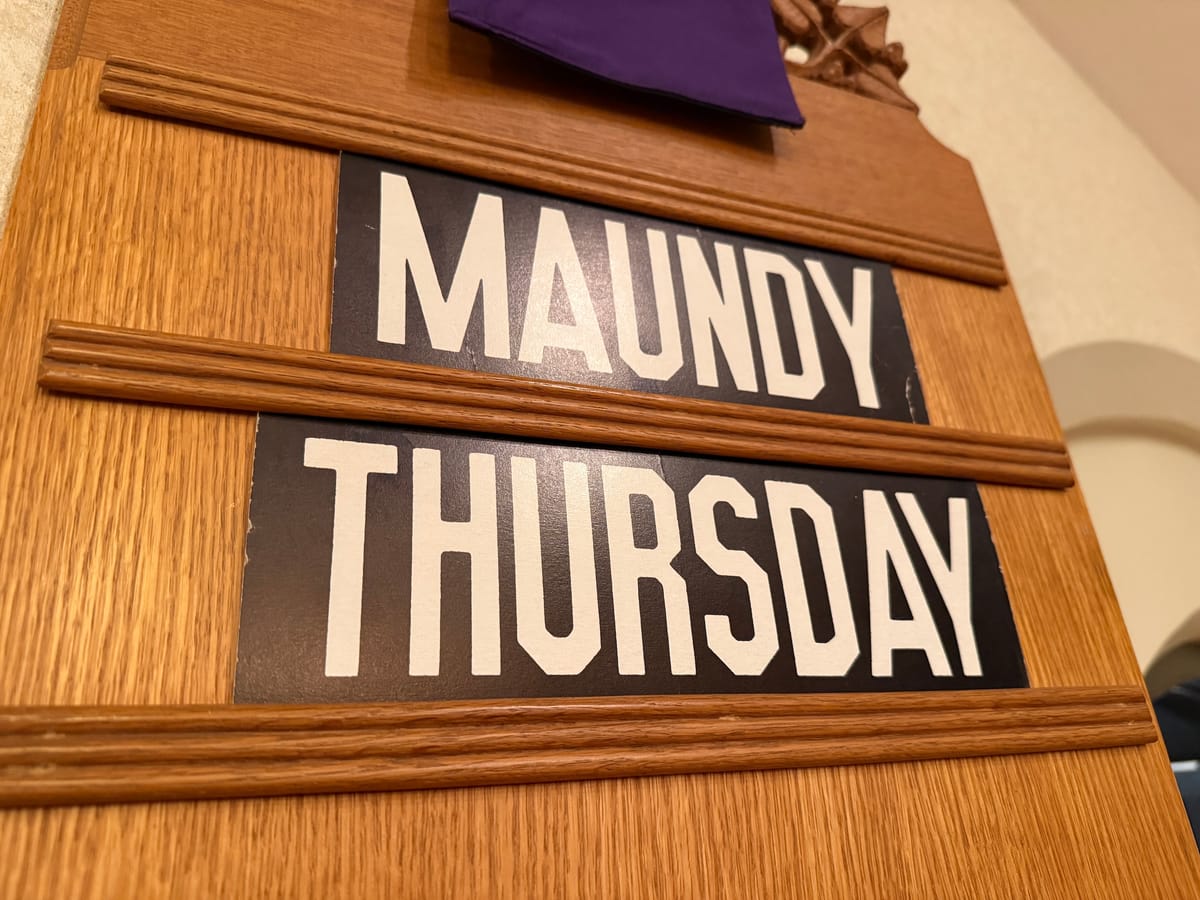
Tonight is Maundy Thursday. As some of you good Catholics will know, Maundy comes from the Latin word mandatum, meaning “command” or “mandate.” Mandatum became Maunde which became Maundy, so this Maundy Thursday is Commandment Thursday, or Mandate Thursday. The lectionary selection from the gospel of John skips over the command to break bread together because Paul covered that in his letter to the Corinthians, but it includes the parting commandment of love. So, we are left tonight with a few commands from Jesus our Savior, a few mandates: love one another as Jesus loved us… keep the Eucharist, break bread, drink wine… and wash each other’s feet.
Our church doesn’t consider washing feet a sacrament, but we do consider it an important annual marker of our faith. This is our chance to join in the story of Jesus right before the crucifixion. For us tonight, it is like the Eucharist, it is a moment of anamnesis, pulling the past into the present and bringing all of our stories together into one. We join with Jesus and the disciples in washing each other’s feet, we join with the saints and the Christians who have gone before us, we join with all of them in this act of service to each other in the mystery of our centuries-old faith. We are united tonight through the ages with this simple act, mirroring the simplicity of our bread and our wine, the simplicity of the waters of baptism. We are united with Jesus, with others, and we are not alone.
You might still not want to wash someone’s feet, and that’s okay. One more thought: Father Esau McCaulley, an Anglican priest who attended Sewanee but was raised in the Primitive Baptist Church, he grew up washing feet at church on the second Sunday of every month. In his book about Lent, which we read here last year, he writes this: “I never learned to enjoy foot washing. I’m not sure joy was the intent. Service and mutual love are hard work. Sometimes, we must grab sweaty feet and say to the person to whom those sweaty feet belong, ‘You are loved and valued, not just by your brothers and sisters in Christ, but by God too.’ Foot washing is gospel work. It was not fun, but it was good.”
Service and mutual love are hard work, but they are good work, they are gospel work. Tonight, in this twenty-first century, foot washing is an unusual, not-so-commonplace symbol for us of the service we do for each other, the service we allow others to do for us. If ever there was a world in need of humble service, a world in need of love for our neighbors, a world in need of mutual love for each other, this may be that world.
How much more important, then, are rituals that symbolize and embody service and love in the very action of carrying it out? Look around us, read the news. We desperately need more humble service and mutual, sacrificial love in this world today. We need to repeatedly find ways to join in that service and love that Jesus showed us before and leading up to his death. We need to join in the centuries of service and love that Christians have lived in times like these and in times harder than these. And we need this night, these commands, to remind us every year that our life as Christians is at its heart a life of service and love, even though service and love is not always easy. It is not easy to serve at the pantry. It is not easy to give of our money to those in need. It is not easy to show up on Sunday mornings to worship together. It is not easy to prepare the meals or wash the dishes after community brunch. It is not easy to serve in all the ways that we serve. But this is our one life to live; let it be marked by humble service and mutual love.
As Jesus’s last acts with his disciples before the events of Good Friday, Jesus gave us the mandatum, the mandate, to love each other, to break bread together, and to wash each other’s feet. Tonight, we will do all of those things. May the spirit of humble service and mutual love embodied in this service, in this night, in this place, in these rituals that mark time and mark us, may that spirit inspire us and carry us through the rest of this Holy Week and this entire year, for a world who needs us to live in them every single day.
Amen.