The Patriotism of Loving, Hyphenated Strangers
Christians of all nationalities are called into this way of life, loving everyone, even our enemies, even the strangers, let alone our neighbors.
The Sixth Sunday after Pentecost, Year A
Sermon for July 5, 2026
My friends, I speak to you today in the name of one God: Father, Son, and Holy Spirit. Amen. Please be seated.
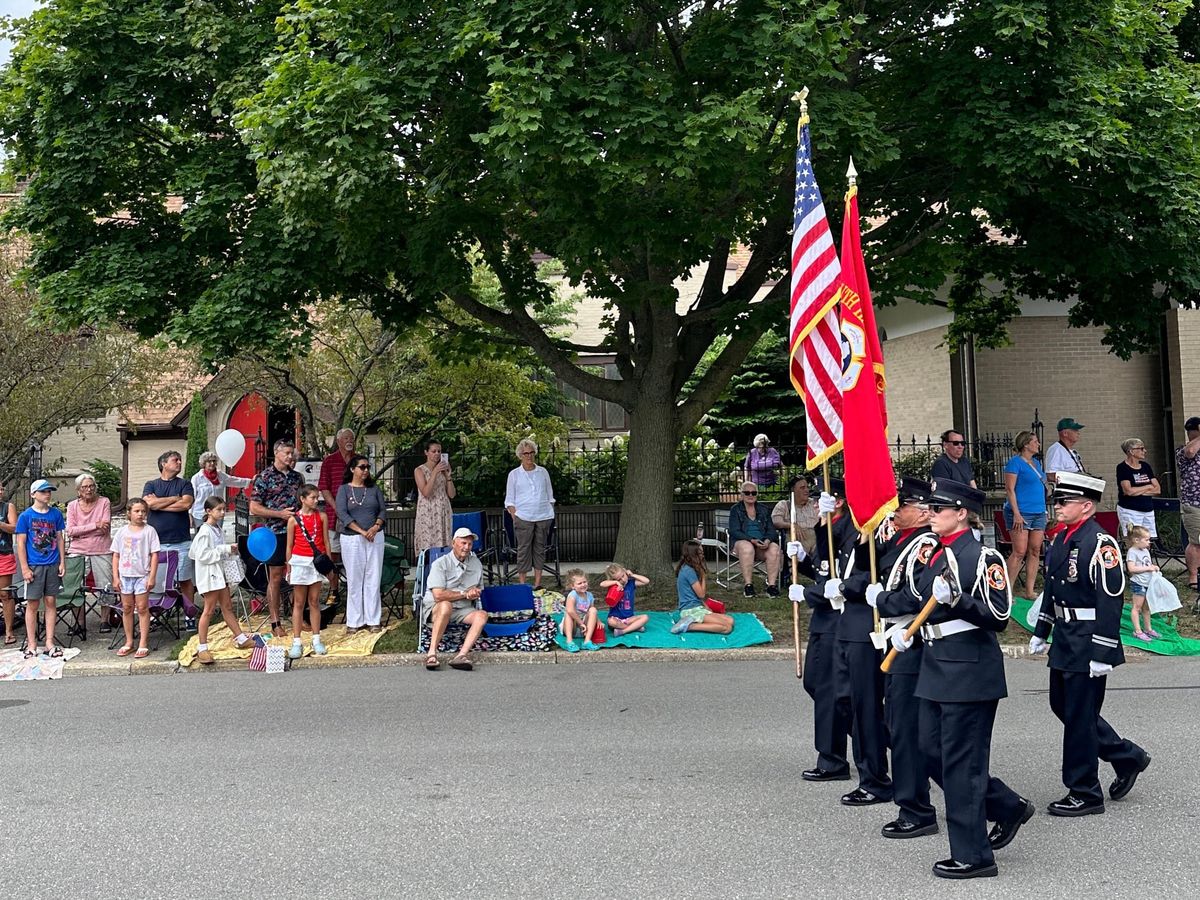
Good morning, Church of the Epiphany. Happy Fourth of July Weekend. We saw several of you Friday night at the rain-soaked fireworks; my family avoided the worst of the storm on the Plechaty front porch. Then we saw many of you yesterday at South Haven’s Independence Day parade, right here on Kalamazoo Street. I handed out red, white, and blue popsicles; some of you were marching yourselves. It is a festive weekend in town.
My question for you this morning, amid all the festivity, is: how festive do you feel on this, the 250th birthday of our country? Was this any different from other years? How patriotic are you feeling these days? Could we, as members of the Church of the Epiphany, as Episcopalians, as Christians, did we feel excitement and joy this weekend?
I know I’ve talked to a few of you who remember celebrating in 1976, the bicentennial. This was before my time, as many of you know, “back in the olden times,” so I have to take your word for it, but it sounds from your own reports like there was a common spirit of festivity that year, all around the nation. PBS reported the same this week, so you’re not just remembering with a bit of nostalgic amnesia. Historians tell PBS that “Though they were exhausted by the 1960s and an important Civil Rights movement, by the Vietnam War, by Watergate, and dealing with recession and economic strain, Americans used the bicentennial as a coping mechanism, putting aside contemporary struggles and coming together to celebrate a shared heritage and spirit.” Doesn’t that sound nice? I don’t think we’re there today. That’s not the report I’ll write about today in 25, in 50 years’ time.
For my part, I’ll probably remember the reflecting pool and the fair on the National Mall. But more personally, I’ll remember this service, if I’m honest, this strange look back to 1776, the Anglican Patriots, and their use of the 1662 Book of Common Prayer. I’m happy our Episcopal leadership suggested this liturgy; it connects us with that time in a way few things can. I’ve pointed out before that most Church of England colonists were likely Loyalists or neutrals in the fight for independence. You may know the “Farmer” character in the musical Hamilton who stands up and opposes the patriots – “Chaos and bloodshed are not the solution” – he was one of our first Episcopal Bishops, Samuel Seabury. Hamilton is big at our house; I think Lily has more of it memorized than I do.
We also watched Mel Gibson’s 1999 movie The Patriot this week, along with part of Independence Day, the 1996 movie with Will Smith. And of course, like every good red-blooded American, we had hot dogs and apple pie yesterday too, too much of both, always, though not nearly as many hot dogs as Joey Chestnut had. On Coney Island yesterday, I believe he ate 66.5 hot dogs. He reigns another year as our hot dog king.
But why all these references? Hamilton, The Patriot, Mel Gibson, Will Smith, Joey Chestnut, hot dogs, and apple pie… well, I believe in America we’re all looking for something in common. In this land of immigrants, where most of us have a hyphenated heritage, we want to feel at "home," and so we have movies, food, sports, we have fireworks, parades, and flags to wave. But no matter what creed we may profess, what law we may choose to live under, none of us can trace our ancestry on this continent much beyond 250 years. Our ancestors, the colonizers and colonists, they made sure of that with the widespread slaughter and forced removal of those who lived here before them. This is something we try to acknowledge and mourn now, try to atone for whenever we can.
But, now, we could look around this room on any Sunday and see self-professed “Irish Catholics,” Scottish Americans, Italian Americans, Russian Americans; at other churches in our diocese, we would see African Americans, Hispanic Americans, and other European Americans in our pews. I may think of myself as an “English-American,” with many of my family roots in Yorkshire, but my dad would point out that I have Scottish and German and Swiss blood too. Many of us are interested in our ancestry and our heritage, for some of us it’s an interesting hobby, this look back at who our ancestors were. And yet, for most of us, we ourselves were born in America. Under fireworks and the waving red, white, and blue flag, whether we like our President or not: we are Americans.
So, what does it mean to be an American this weekend, in 2026, and more particularly and especially for us, what does it mean to be an American Christian today? In a nation of division and fear and anxiety, in a United States where the Nazi phrase “blood and soil” is commonly referenced from the highest halls of power, to claim an American heritage and identity for some and not for others? How do we navigate this patriotism?
The lectionary readings chosen in our Episcopal tradition for the feast of Independence Day give us a good starting point. Our Old Testament reading and our Epistle reading both reference Jewish history, where the people of Israel were strangers in a foreign land. In Deuteronomy, we read that God, “the God of Gods and the Lord of Lords, the great God, mighty and awesome,” God loves the strangers, the immigrants, providing them food and clothing, and we should too. In Hebrews, we read that Abraham, Isaac, and Jacob were all foreigners themselves, living in tents, seeking a homeland but desiring a better country, “that is, a heavenly one,” not the land they left behind. God has prepared a heavenly city for them, and has for us too, if we’d only choose to live in it.
And of course, in Matthew, we have one of the most radical and beautiful commands ever written: “You have heard that it was said, ‘You shall love your neighbor and hate your enemy.’ But I say to you, love your enemies and pray for those who persecute you, so that you may be children of your Father in heaven; for he makes his sun rise on the evil and on the good, and sends rain on the righteous and on the unrighteous.” Friends: Christians of all nationalities, hyphenated and otherwise, are called into this way of life, loving everyone, even our enemies, let alone our neighbors. Praying for them, because all of us enjoy the same sun and rain, no matter our borders or our politics, our fireworks or our flags. It is love, for everyone, especially those with whom we disagree, always.
And we know that we will have enemies, thanks to the reading from a few weeks ago: Jesus did not come to bring peace but a sword. Our enemies are those from all political parties and backgrounds who abuse the stranger, the foreigner, the orphan, the widow. Our enemies are those who are greedy, who pursue power for personal ends, who hoard wealth, who bomb and kill innocent children. As Christians, our enemies are not Muslims or Jews, Buddhists or Hindus, Atheists, Liberals or Conservatives, but our enemies are those who make this land unlivable for the vulnerable, who destroy this created world.
And with our enemies identified, what does Jesus say we as Christians should do to them? We love them anyway, and we pray for them. We love them because God loves them too. This does not mean we do not call them to account, nor that we stop fighting their injustices using the systems of power we have voted into place, but if we do so out of our own anger and hate, we are missing the point of what it is to be Christian. We have forgotten that our enemies too are loved by God, that they need grace, just as we do. Our God’s version of love is to care for the stranger (and we are all strangers), to turn the other cheek, to walk another mile, to show through our love a better way forward for all of us.
Friends, our call this morning in our divided United States of America, on its 250th birthday no less, is simply to love. To love our neighbors, to love our enemies, to love the stranger, to love the immigrant. In a nation where we are nearly all hyphenated Americans, may we cherish our freedom to worship and to love God and our neighbor and our enemy extravagantly, without end, and may we do so. My prayer this weekend is that what we hold in common as flag-waving Americans may be more than fireworks, apple pies, and hot dogs; may it instead be love and welcome for all, no matter where we or our parents were born, no matter our skin color, our gender, our language, or our political party.
This could be the promise of our America in its next 250 years, should we choose it: not fear, but love.
May our flag remind us all today and every day of our shared status as strangers in this land, and may we commit as Christians and as Americans this morning, to love as we ourselves are loved. No exceptions.
Amen.